


Ever wondered if virtual reality can boost clinical skills? Imagine training in a digital world where each mistake turns into a lesson. Research shows that VR can improve hands-on skills by about 8% for medical professionals.
Instead of practicing on cadavers or real patients, learners get to experiment in a safe, simulated environment that really mirrors real-life scenarios. This hands-on experience builds confidence long before stepping into an operating room.
In short, VR is turning medical training into an interactive and effective experience that prepares you well for real challenges.
How virtual reality in medical training transforms learning outcomes
Virtual reality is changing the way clinicians learn by offering a safe space to practice procedures that used to require cadaver labs or real-life experience. With VR, healthcare professionals can rehearse critical procedures in a controlled setting where mistakes turn into learning moments rather than disasters. In fact, studies show that surgeons using VR platforms improve their technical skills by about 8%. Imagine a surgeon using a headset to explore a digital twin of a patient’s anatomy, crafted from real MRI scans. This method gives clinicians hands-on experience without any risk, boosting their confidence before stepping into the operating room.
Interactive simulations go beyond just sharpening technical skills. They also help build empathy by allowing students to step into a patient’s shoes. This way, medical learners can improve their communication and bedside manner. For example, a simulation might have a student guide a patient through a challenging diagnosis, offering a clear insight into what patients experience. This first-hand understanding leads to better care overall.
Another exciting benefit of VR training is its flexibility. With on-demand sessions available remotely, institutions can cut down on costly cadaver lab fees by setting up digital classrooms where learners can practice anytime, anywhere. This approach is especially important given the rising need for doctors and the high cost of medical education. As VR tools continue to evolve, educators receive more precise feedback through motion tracking and other systems that monitor progress. All this clear data reinforces VR’s role in modern education, paving the way for safer and more effective clinical training.
Virtual reality in medical training platforms and technologies

Virtual reality is shaking up healthcare training like never before. Today’s digital platforms create immersive, hands-on learning experiences that feel almost like real life. Take the EON XR suite, for instance, it mixes tools like EON-XR, EON Spatial Meeting, EON Metaverse Builder, and EON AI Assistant to build digital twin environments. These virtual worlds let doctors and nurses practice procedures with smart, AI-powered guidance, offering realistic scenarios in a safe space along with quick, honest feedback.
Modern VR systems are getting even smarter by blending spatial awareness (think knowing exactly where everything is) and career-focused modules. Imagine a student watching a simulated surgery with digital pointers highlighting the key moments. These interactive experiences boost not only technical skills but also essential soft skills like clear communication and rapid problem-solving. Experts even noted in a Spatial AI Knowledge Transfer Webinar that such simulations help close the gap between textbook theory and hands-on clinical practice.
Over in California, a virtual campus event showcased these capabilities with live tools that connected students and teachers in real time. Collaborations with data-systems companies are now fine-tuning these technologies to create adaptive, AI-powered XR learning environments tailored to each learner’s pace. All in all, this growing ecosystem of innovative tools is redefining healthcare education and setting the stage for the future of medical training.
Virtual reality in medical training case studies and research
In November 2022, the Columbia Clinical Innovation Lab kicked off an exciting VR ultrasound training program. This revolutionary setup let medical students practice things like central line insertions on virtual patients. It’s a game-changer, offering a risk-free way to move from classroom theory to real-life skills.
Studies have shown that surgeons who train with VR see about an 8% improvement in their technical abilities. Imagine a surgical resident repeating a delicate procedure in a virtual world, using modules that even incorporate real MRI or ultrasound scans (detailed body images). These tailored simulations let them learn the unique details of each case and fine-tune their techniques with each run.
Research into simulation-based learning in medicine tells us that practicing in VR helps skills stick. One study even found that those using these simulations tend to make fewer mistakes compared to traditional training methods. Every error in the VR world becomes a lesson, turning challenges into opportunities to improve, which is both smart and efficient.
A survey from 2017 revealed that about 65% of nursing programs were already experimenting with visual technologies, and at least 50% were planning to add VR to their courses by 2025. With VR, nurses can confidently practice handling emergencies and complex care routines without putting anyone at risk.
Overall, these case studies and research findings really highlight the value of immersive VR in medical education. As more institutions adopt this technology, we can expect faster skill development, shorter learning curves, and ultimately, better care for patients.
Virtual reality in medical training for skill development
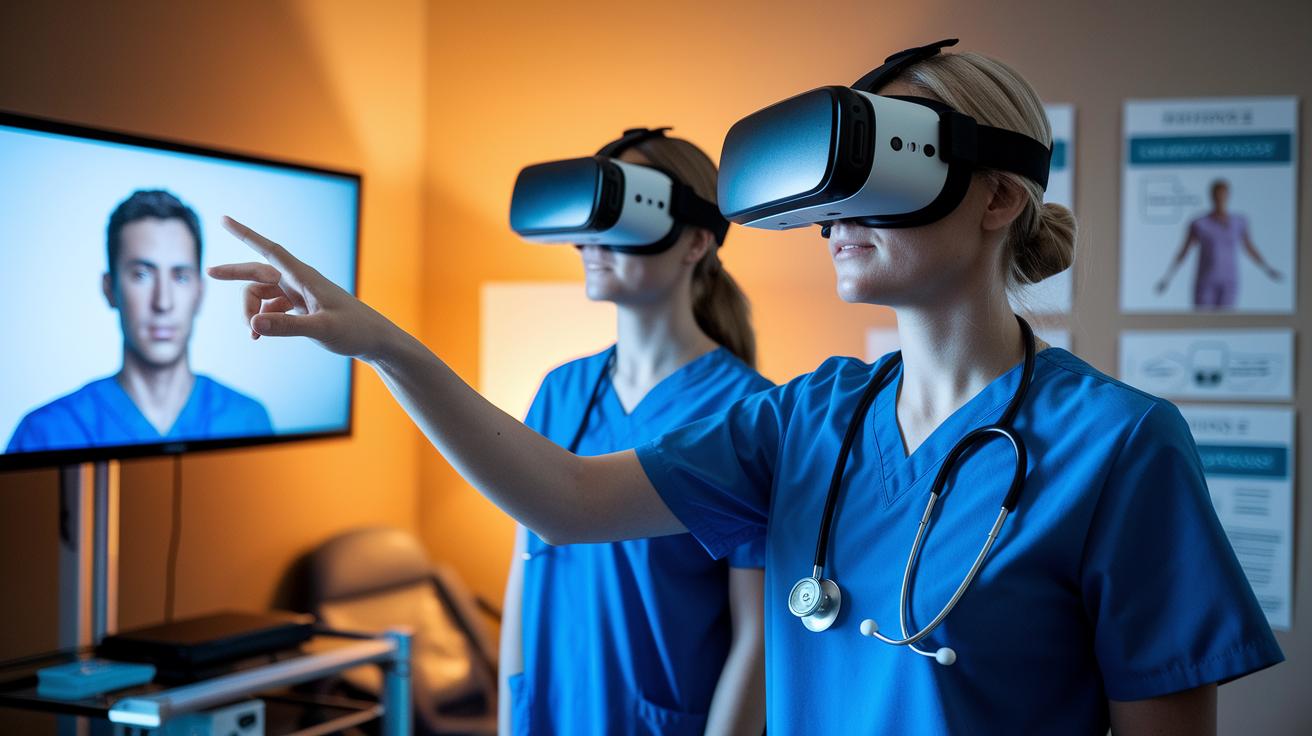
Recent studies show that using advanced VR simulations can boost residents' decision-making skills by 30%. One resident shared, "I felt like I was managing a real-life crisis with every critical second," which really highlights the improvements these simulations can bring.
VR training now mixes surgery practice with interactive empathy modules that let caregivers see things from a patient's perspective through lifelike avatars. These new modules build on earlier immersive techniques, giving trainers fresh, clear insights that hadn’t been available before.
Data also reveals that remote VR nursing programs have grown by 40% since 2017, with experts expecting even more use in rural areas by 2025. For instance, a trial at a Midwestern hospital noted faster responses and better teamwork during simulated emergencies.
| Program Type | Reported Improvement |
|---|---|
| Surgical Operative Skills | 30% better decision-making |
| Remote VR Nursing | 40% program growth since 2017 |
Virtual reality in medical training cost-effectiveness and access
Virtual reality is shaking up how we train future doctors by cutting down on really expensive traditional setups. Instead of relying on costly cadaver labs, schools now offer online, on-demand practice sessions through digital healthcare training apps. This change not only saves money but also reduces training mistakes, which means fewer legal headaches and less stress for busy administrators.
Remote simulation in telemedicine training makes quality education available to students in areas where resources are scarce. Imagine being able to practice surgical techniques right from your own home at any time. This kind of access is a game changer for places that lack modern medical facilities, giving future healthcare professionals the hands-on experience they need without being tied to a specific location.
The financial perks of this tech go hand in hand with its ability to scale. As virtual reality keeps improving in medical education, its streamlined training programs further lower costs per student. With projections showing the VR healthcare education market could top $165 billion by 2026, there's a strong economic case for immersive tech. Not only does this approach meet today’s training demands, but it also helps ease the expected shortage of doctors by making clinical skills training both accessible and affordable for a wide range of schools.
Virtual reality in medical training effectiveness metrics

VR training really makes a difference compared to old-school methods. When doctors and nurses use VR, they remember about 75% of the details from their sessions – a huge jump from the 5% retention seen in lecture-based formats. That extra memory boost means they can recall vital steps long after training ends.
Using VR also helps learners stay focused. In fact, trainees using VR show 50% more concentration and finish their training modules four times faster than those in traditional classrooms. Imagine getting through complex procedures quickly while still holding onto all the important details!
Surgeons have noticed improvements too. Those who train with VR see about an 8% lift in their technical skills. This boost is picked up by tools like motion capture systems and simple analytics dashboards, giving real-time tips for improvement. It’s like having a friendly coach guiding you every step of the way.
All these clear metrics show that VR training gives precise, easy-to-understand feedback. Educators can track exactly how well each session is going and fine-tune the training on the fly, making the whole process both effective and safe.
Virtual reality in medical training challenges and future trends
Many schools and hospitals are feeling the pinch from the high start-up costs of VR. They’re often trying to blend new VR tools with older equipment, which can slow down how quickly they adopt these technologies. A lot of administrators are getting creative, reworking old systems so they can mix hands-on digital simulations with traditional methods without too much disruption.
New VR solutions bring in features like AR overlays (which add digital images to the real world) and flexible, modular designs. These options let educators roll out simulations bit by bit, easing the immediate budget strain and smoothing the transition. Live events like spatial AI webinars and virtual campus tours offer real-life examples of how these systems work, sparking interest and boosting collaboration among developers, doctors, and educators. It’s kind of like watching a live workshop where everyone learns from each other, and that shared energy helps drive even more innovation.
The global market for VR in healthcare is booming. Innovations such as digital twins (exact digital copies of physical objects) and AI-assisted training scenarios are changing the face of medical education. Researchers are digging deep into how well these simulations work and setting up clear standards to measure new skills. Many training centers and academic institutions are now using controlled studies to show that these modern methods can match, and even beat, traditional learning techniques. In truth, this careful research and ongoing refinement of both the tech and the training content are paving the way for the future of immersive medical training.
• Upfront cost challenges
• Integration with older systems
• Step-by-step modular program designs
• Increased collaboration and research efforts
Final Words
In the action, this article highlighted how virtual reality in medical training reshapes learning outcomes by blending immersive simulation with real-life data. It walked through innovative platforms, practical case studies, and measurable improvements in skills and empathy. Learning tech that uses actual patient scans and responsive AI has shown promise in cutting training expenses and extending access. The discussion drives home the value of embracing advanced methods while keeping education hands-on and accessible. Here’s to a future filled with more smart, engaging breakthroughs in healthcare simulation!
FAQ
What is covered in a virtual reality in medical training PDF?
The virtual reality in medical training PDF explains how immersive simulations let healthcare professionals safely practice high-stakes procedures and improve technical and soft skills while lowering training expenses.
How does online virtual reality in medical training work?
Online virtual reality in medical training offers on-demand, immersive modules that allow remote practice of procedures, providing interactive learning experiences and immediate feedback to boost skill retention.
What advancements were seen in virtual reality in medical training in 2022?
In 2022, virtual reality in medical training expanded with programs using real patient scans and interactive simulations, leading to improved surgical proficiency and enhanced empathy in healthcare education.
What information does a virtual reality in medical education PDF provide?
The virtual reality in medical education PDF outlines how simulation-based modules improve technical skills, reduce errors, and increase access through flexible, remote training solutions.
How is virtual reality applied in healthcare?
Virtual reality in healthcare is used to develop immersive training tools that simulate surgeries, emergency scenarios, and empathy exercises, helping professionals refine their skills in a safe, controlled environment.
What developments occurred in virtual reality in medical training in 2021?
In 2021, virtual reality in medical training emerged with programs like VR ultrasound and surgical simulations that provided measurable gains in technical skills and enhanced knowledge retention.
What do VR medical training companies provide?
VR medical training companies create platforms featuring realistic, immersive simulations and AI-driven feedback that enable healthcare professionals to practice complex procedures safely and effectively.
How does virtual reality training benefit healthcare professionals?
Virtual reality training offers interactive, real-life simulations that sharpen clinical skills, boost decision-making in urgent scenarios, and improve patient care through realistic, hands-on practice.
How is VR used in medical training overall?
VR is used in medical training to simulate surgeries, emergency interventions, and empathy exercises, providing immersive, hands-on practice that enhances both technical precision and patient interaction skills.
How can virtual reality be used for training?
Virtual reality is used for training by creating realistic scenarios where learners can rehearse procedures, refine techniques, and receive instant performance feedback in a risk-free simulated environment.
Can virtual reality simulate surgeries for healthcare training?
Virtual reality can simulate surgeries by offering detailed 3D environments and real patient imaging, enabling healthcare professionals to rehearse operations safely and improve their technical proficiency.
What are the five domains of medical extended reality technology?
The five domains include immersive surgical simulation, diagnostic imaging and procedural planning, emergency response training, empathy and communication skills enhancement, and remote collaborative learning.