


Ever thought about how computers might think more than just on or off? Bits in regular computers work like simple light switches that can only be off or on. Qubits, on the other hand, are more like a spinning coin that shows both heads and tails until you take a closer look.
In this article, we’re diving into seven different types of qubits. These clever bits can help tackle really tough challenges, like keeping code safe or modeling complex systems. It’s pretty amazing to see how these quantum bits are sparking fresh ideas and new ways of using computer power.
Qubit Fundamentals in Quantum Computing
In everyday computers, a bit is like a light switch, it's either off (0) or on (1). But a qubit can be both at the same time (this is called superposition, which means it holds multiple possibilities until you check). Imagine flipping a coin that somehow lands as both heads and tails until you peek. This neat trick lets qubits do many calculations all at once, which can speed up solving tough problems in AI, materials science, and secure coding (cryptography).
Superposition is the magic behind qubits, giving them a level of parallel computing that classic bits just can't match. And when qubits interact, they can get linked in a process known as entanglement (a connection where the state of one instantly affects the other, no matter the distance). So, if you check one of these connected qubits, its partner instantly shows a related result.
But here’s the catch: the moment you measure a qubit, its superposition collapses into a single state, either 0 or 1. This collapse is what lets us read the result, though keeping qubits stable for long computations is a big challenge.
| Property | Classical Bit vs. Qubit |
|---|---|
| State Representation | 0 or 1 vs. superposition of 0 and 1 |
| Measurement Impact | Unaffected outcome vs. state collapse upon observation |
Understanding these basics opens up a whole world of possibilities in quantum computing. The dance between superposition, entanglement, and measurement might just rewrite the rules of computing as we know it. Have you ever wondered what new breakthroughs might come as we explore these concepts further?
Key Qubit Types in Quantum Computing Qubit Architectures
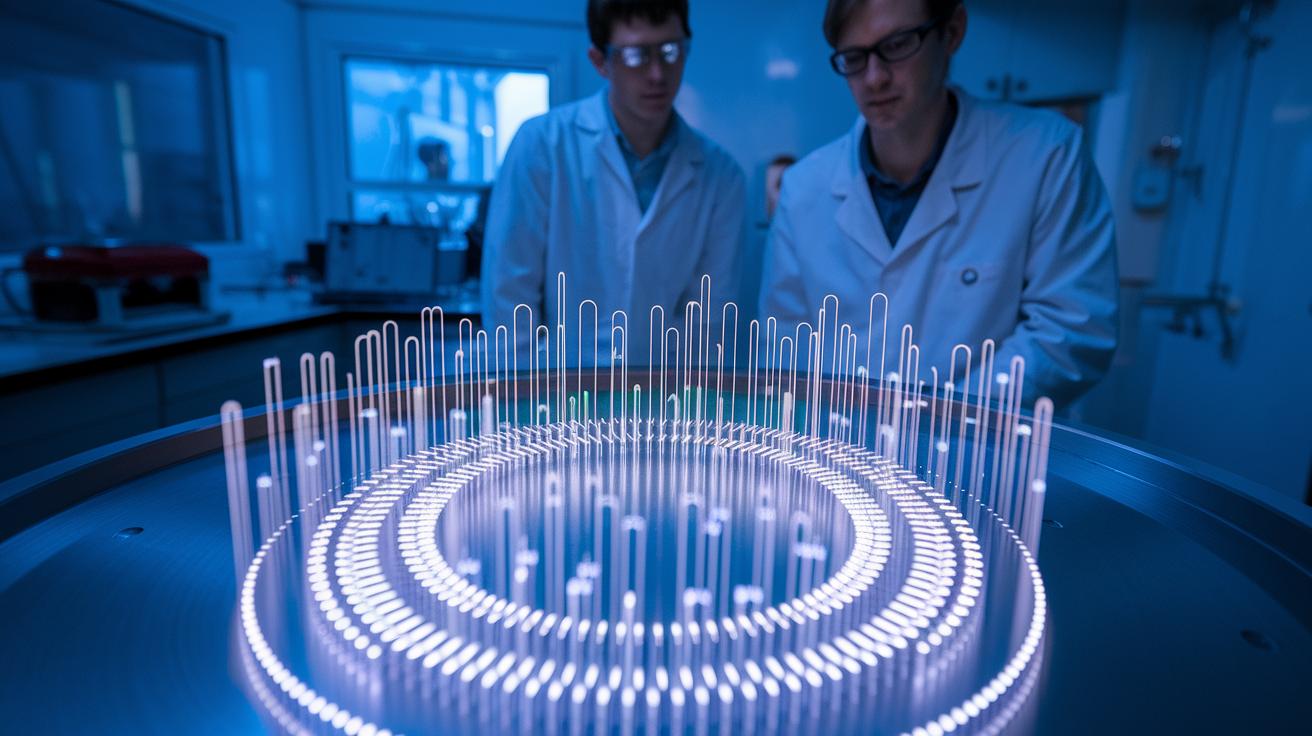
Superconducting Qubits
Superconducting qubits are built from circuits that respond to microwave pulses, which tweak things like magnetic flux, charge, or phase. These circuits use tiny paths to guide electrical current at extremely low temperatures. For instance, Google’s Sycamore chip in 2019 showcased how these qubits could tackle specific challenges, while IBM’s 127-qubit Eagle system from 2021 pushed the boundaries even further. Imagine a delicate circuit that moves in sync with microwave pulses, where each tiny adjustment sparks a leap in processing power. It’s like watching a mini dance show where each move brings out a burst of quantum energy.
Trapped Ion Qubits
Trapped ion qubits work by capturing ions with electric fields and then steering them using laser pulses. This clever method has been refined over decades since experiments began in 1995. Think of the ions as little marbles carefully balanced in a glass case, each held in place by electromagnetic forces. Thanks to this gentle setup, they can maintain their orderly states longer, giving scientists more time to do important calculations. It’s like carefully aligning puzzle pieces with a subtle nudge from a laser pointer.
Photonic Qubits
Photonic qubits use photons, or particles of light, that connect through special entanglement and travel along optical pathways. Their real strength lies in linking different parts of a quantum processor, opening up the possibility for larger, more connected quantum networks. Picture beams of light acting as tiny messengers, weaving together different sections of a chip to form a vast communication network. With this setup, quantum computers could eventually grow much larger and work together more seamlessly than ever before.
Physical Properties and Hardware Integration of Quantum Computing Qubits
Superconducting Circuit Integration
Superconducting qubits live inside special refrigerators that keep them super cold, around 10 mK, using ultra-cold systems. They are built on materials like silicon or sapphire, where tiny resonators, control wiring, and waveguides are crafted with advanced nanotech (tiny machines at work). Engineers use microwave pulses and precise control electronics to tune these circuits, often reaching over 99% accuracy. Fun fact: in one test, a tiny superconducting circuit worked perfectly in a fridge almost as cold as outer space. This careful setup creates a stable and quiet space for the circuit to do its magic.
Trapped-Ion Hardware Integration
In trapped-ion systems, ions are held in place within a vacuum chamber using special electrode arrays. Tiny laser pulses are used to nudge the ions with perfect precision, imagine arranging marbles in a perfectly organized, sealed container and gently touching each one. Thanks to the super-clean environment, these ions stick around longer, making the system perfect for a range of tasks.
Photonic State Manipulation
Photonic qubit setups depend on optical resonators, fiber couplings, and on-chip photonics, all built through detailed nanofabrication methods. These parts create complex light pathways for transferring data and linking components. Similar careful adjustments as in superconducting circuits ensure everything works smoothly. Picture beams of light traveling on tiny, meticulously built highways, with each light pulse playing a key role in the whole system.
Error Management Protocols for Quantum Computing Qubits

Quantum computing often struggles because qubits lose their state quickly when the surrounding environment interferes. These tiny units can only keep their state for a few microseconds to milliseconds. To tackle this, researchers use smart quantum error correction techniques that automatically spot and fix mistakes in both bit values and their phases, kind of like having a built-in spellchecker for your computer's thought process.
They also spread the important information across many physical qubits. This means that if one qubit acts up, the overall calculation still stays on course. Think about it like a trapeze act with several safety nets, if one net fails, another is there to catch you.
Noise suppression is another key part of keeping qubits working well. Techniques such as dynamical decoupling use quick pulses to cancel out bothersome low-frequency noise, much like noise-canceling headphones reduce unwanted background sounds. Researchers often use surface-code methods (a type of quantum error correction) to catch problems early and correct them fast.
Together, these strategies make quantum operations much more resilient, holding quantum states long enough to perform complex tasks. Imagine a perfectly synchronized orchestra where each instrument gently adjusts its tune to keep the melody flowing, that’s the magic behind these error management protocols and their role in advancing quantum computing.
7 quantum computing qubits ignite promising ideas
Quantum computing qubits are fueling a host of creative applications in both industry and research labs. Thanks to the neat trick of superposition (where bits can exist in more than one state at the same time), these qubits can run special quantum algorithms that solve tough problems faster in areas like logistics, finance, and machine learning. Have you ever wondered how they do it? Recent experiments have shown that quantum computers can solve certain problems, like random circuit sampling, with remarkable speed.
Cloud-based quantum platforms are also changing the game. They give researchers access to powerful computing resources that help with tasks such as training AI models, simulating materials, discovering new drugs, and analyzing financial risks. In simpler terms, they make complicated jobs easier and open up exciting new possibilities in technology.
- Optimization in supply chain and portfolio management
- Cryptography and secure communications
- Materials and chemical simulation for drug discovery
- Machine learning model training and classification
- Financial modeling and risk analysis
Each of these uses takes advantage of the incredible parallel processing power of quantum computing, which means they can tackle many tasks at once. Progress in designing better algorithms and integrating these new systems is steadily changing how we tackle industry challenges. It’s an exciting time, as these innovations could soon redefine our whole idea of computing.
Recent Advances and Scalability Prospects for Quantum Computing Qubits

Recent breakthroughs in quantum processing are expanding what qubits can do. In early 2025, engineers introduced a 6,100-qubit processor that far outpaced earlier systems, which typically had around 1,000 qubits. This huge leap shows that scientists are making real progress in growing quantum systems and setting the stage for more powerful computing.
Today, researchers are focused on building systems that can easily scale up. They’re exploring ways to link several smaller quantum modules into one large, efficient unit, kind of like snapping together pieces of a puzzle. These new designs help handle growing complexity by improving communication between modules and managing errors more effectively.
Looking ahead, the next steps involve diving into hybrid superconducting designs and fine-tuning advanced control electronics to solve stability challenges. Researchers are also testing new device platforms intended to build resilient quantum systems that keep running smoothly, even under heavy loads. With each innovation, quantum processors edge closer to solving complex, real-world problems and opening exciting doors for future technologies.
Final Words
in the action, we examined the fundamentals of quantum computing qubits by contrasting classical bits with qubits and exploring superposition, entanglement, and state collapse. We also looked at various qubit types, superconducting, trapped-ion, and photonic, and discussed how they integrate with specialized hardware and error management techniques. These insights show how quantum computing qubits are key in powering breakthroughs in AI, cryptography, and beyond. The advancements we saw set an upbeat tone for exciting, future scientific and tech progress.
FAQ
What are qubits in quantum computing?
The qubits in quantum computing serve as the basic unit of quantum information, holding combinations of 0 and 1 simultaneously to enable complex calculations beyond classical bits.
How do qubits differ from classical bits?
The qubit differs from a bit by existing in a blend of states (superposition), while a bit is strictly 0 or 1. This capacity lets quantum computers work on multiple possibilities at once.
What are qubits made of and what types exist?
The qubits in quantum computing are crafted from materials like superconducting circuits, trapped ions, or photons. Each type utilizes unique quantum effects such as superposition and entanglement.
How many bits are in one qubit or how many qubits does a quantum computer have?
The qubit doesn’t convert directly into bits; its superposition allows it to represent many possibilities. Quantum computer sizes vary from a few qubits to systems recently recording over 6,000.
How powerful is a 1,000-qubit quantum computer?
The 1,000-qubit quantum computer harnesses exponential processing capacities, offering significant speed-ups in solving optimization, simulation, and cryptographic tasks compared to classical processors.
Is there a 1 million qubit quantum computer?
There isn’t a 1 million qubit quantum computer yet. Current research focuses on scaling qubits while managing error rates—a complex challenge that remains in early stages.
What do Reddit discussions cover regarding quantum computing qubits?
The discussions on Reddit about quantum computing qubits highlight experimental breakthroughs, technical nuances of qubit design, and accessible explanations that simplify complex quantum ideas.
| Property | Description |
|---|---|
| State Representation | A classical bit can be only 0 or 1; a qubit exists in a superposition, holding both values at the same time. |
| Measurement Impact | Measuring a bit reveals its fixed value, while measuring a qubit collapses its quantum state to a definite outcome. |