


Have you ever wondered if computers could run faster when they’re nearly frozen? It turns out that cooling is a big part of keeping those tiny bits of information, called qubits (little data units), stable. Think of it like a race car on a smooth track, where a cooler environment helps everything perform at its best without any hiccups. In this article, we’ll show you how even a slight drop in temperature can reduce interference and why these chilly conditions are needed for top-notch performance. Stick around to learn how keeping things cool can really make a difference in quantum computing.
How quantum computer cooling keeps qubits stable
Quantum computers need to run at extremely cold temperatures to work right. Cooling them close to absolute zero makes sure there’s barely any extra heat or vibrations (tiny shakes you can't see) that might disturb the tiny bits of information we call qubits. It’s a bit like listening to a soft whisper in a quiet room, where every sound is clear and nothing extra interferes.
Different types of qubits need different cooling levels. For instance, superconducting qubits must be kept below one Kelvin so that electrical current flows smoothly without any resistance. Meanwhile, silicon spin qubits work best at temperatures measured in millikelvins, which fits well with current chip-making methods. There are also trapped ion or neutral atom qubits that require very cold conditions, while photonic qubits are a bit more relaxed because they can handle warmer temperatures. Imagine a race car needing a smooth track, it’s the same idea: these systems need just the right amount of cold to run their best.
Keeping the temperature just right is key to avoiding mistakes and making sure everything runs smoothly. Advanced tests in these ultra-cold conditions check how long qubits can keep their state, how few errors happen, and how reliable the whole system is. Even a tiny change in temperature feels like a missed note in a carefully tuned instrument, so constant monitoring is a must for reliable quantum computing.
Cryogenic control systems for quantum computer cooling

At the core of cooling quantum computers, you'll find cryogenic control systems that work with extreme low temperatures. In these systems, engineers use two main approaches, one uses liquid helium (a very cold liquid) in wet systems, while the other relies on cryogen-free or "dry" refrigerators that work with pulse tubes or Gifford-McMahon coolers (mechanisms that cycle refrigerant to reach low temperatures). Think of it like picking between a traditional waterwheel and a modern wind turbine; each method has its benefits yet both achieve that deep freeze needed for quantum bits.
Building these ultra-cold machines calls for smart cryostat designs. A typical cryostat packs in a vacuum chamber, several layers of radiation shields, and different stages set at temperatures like 4 K, 700 mK, 50 mK, and even lower at the mixing chamber. Imagine a well-organized fortress where each wall helps block out stray heat and vibrations, giving the quantum bits a steady, calm home to work in.
Recent milestones really show off what these systems can do. For instance, in May 2025, Bluefors shipped 18 KIDE systems to Japan’s G-QuAT center, managing to cool over 1,000 qubits down to temperatures just a few thousandths of a degree above absolute zero. By combining advanced cryostat designs with efficient refrigeration stages, these innovations are paving the way for quantum computers that are not only reliable but also scalable.
Mixed-cycle technology fundamentals in quantum computer cooling
Mixed-cycle technology uses different cooling tricks working together, much like a team passing along a secret to get really, really cold. For instance, one method mixes helium-3 and helium-4 (tiny versions of helium) in heat exchangers to lower temperatures to just 5–10 mK. It’s like a cool relay race where every runner plays a part.
Then there’s adiabatic demagnetization, a process that uses magnetic salt pills. First, they magnetize under controlled conditions and then let go, which cools things further into the sub-Kelvin range. And don’t forget about pulse tube cryocoolers; these rely on the expansion of high-pressure gas at the cold head to hit that 4 K mark for pre-cooling.
Cascade refrigeration ties it all together. This method combines cycles like Gifford-McMahon and Joule–Thomson (which involves gas expansion to cool down) to take the temperature from room level all the way down to milli-Kelvin. Each stage is precisely tuned to reduce heat and keep quantum bits stable and clear of noise.
| Cooling Method | Operating Temperature Range | Typical Use |
|---|---|---|
| Dilution Refrigerator | 5–10 mK | Superconducting qubits |
| Adiabatic Demagnetization | 50 mK–1 K | Sensor calibration |
| Pulse Tube Cryocooler | 3–4 K | Pre-cooling stage |
By blending these techniques, engineers create a seamless cooling chain where every method plays a key role. This thoughtful mix helps reduce thermal noise and keeps delicate quantum states intact. It’s pretty amazing to see how careful coordination between different cooling cycles paves the way for reliable and scalable quantum operations.
Ultra-cold quantum computer cooling environments and hardware stabilization
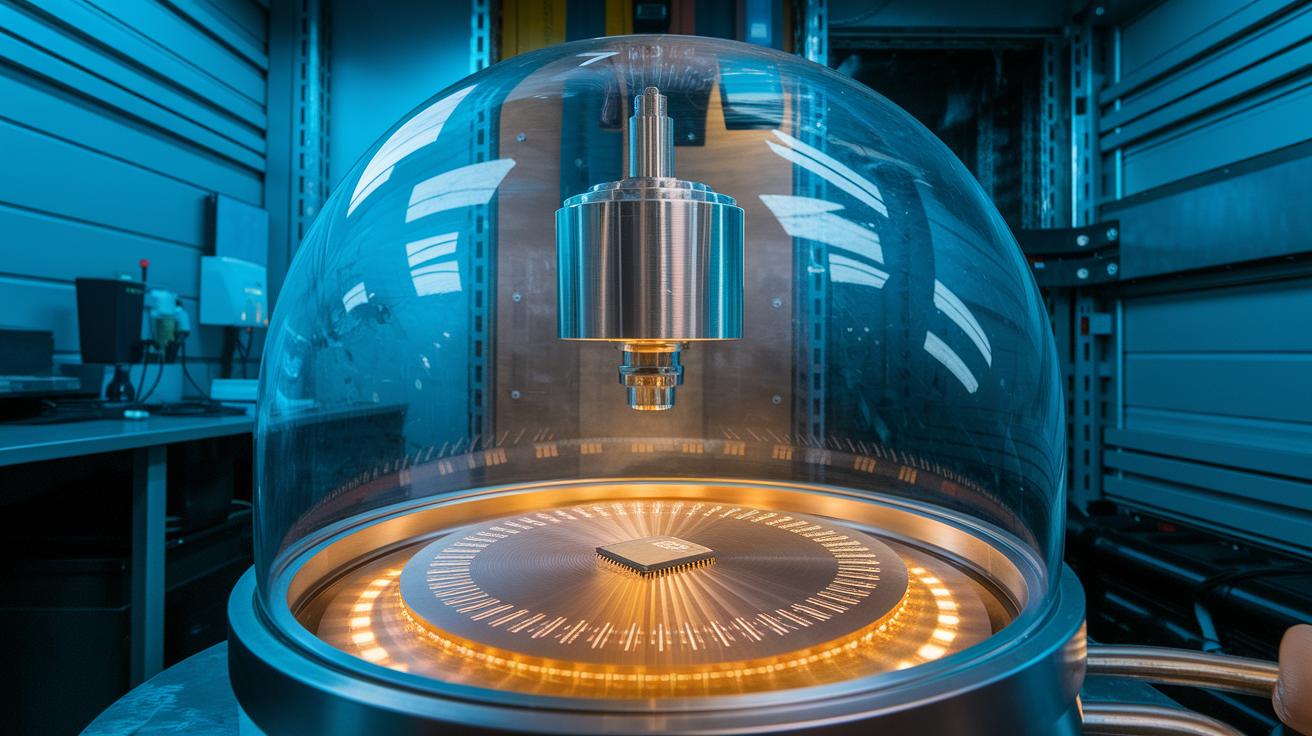
Imagine a cryostat as a soundproof room for temperature. Inside, a strong vacuum acts like a cozy bubble, keeping stray air from warming up the quantum chip. The chip sits on a gold-plated copper plate, chilled to nearly unbelievable milli-Kelvin levels, much like a secret winter wonderland hidden from everyday heat.
Next, think of layers of shields working like sunglasses on a bright day. Multi-stage radiation shields, one at 50 K and another at 4 K, reflect unwanted heat in the form of infrared light and blackbody radiation (energy emitted by objects due to their temperature). This careful design keeps the chip's surroundings quiet and undisturbed.
Vibrations? They can really mess things up. To counter this, engineers use soft-suspension mounts, active damping, and even pulse tube decoupling. Imagine placing your table on special anti-vibration pads that catch tiny tremors before they become a problem.
Finally, precision sensors like Cernox and ruthenium oxide types keep a constant watch over the temperature, accurate to within just ±1 µK. These tiny monitors feed their info into control loops, tweaking the system in real time to fend off any heat or shake that might creep in.
Emerging quantum computer cooling technologies and future strategies
Miniaturized cryocoolers are really stepping up as a neat way to cool quantum systems. Engineers have come up with compact, cryogen-free microcoolers that can give more than 200 µW at 100 mK using less than 100 W of power. It’s like having a tiny engine that delivers big performance, making it possible for smaller systems to reach super cold temperatures and paving the way for real-world quantum processors.
AC-driven adiabatic demagnetization units offer another smart approach. These devices can create temperatures below 5 mK in portable formats by using magnetic fields to lower the heat. Imagine a gadget that chills down with the help of magnetism, it’s a method that could soon lead to more nimble and high-performing quantum devices, all while keeping energy use low.
Laser-based solid cooling is breaking new ground as well. This method uses light (through anti-Stokes fluorescence in solid materials) to cool things down without needing traditional refrigerants. Think of it like using a beam of light as a cooling tool for sensitive quantum processors, offering a fresh way to manage heat even in the tiniest circuits.
Looking forward, researchers are also exploring ways to run qubits at higher temperatures, somewhere between 20 and 77 K, or even close to room temperature. With new superconductors and spin defects (tiny flaws in a material that can influence its magnetic properties), these cryogen-free cooling ideas could simplify designs, lower costs, and open up new possibilities in quantum applications, all while keeping the precise control that quantum systems need.
Case study: Bluefors systems in quantum computer cooling

Back in May 2025, Bluefors set up 18 KIDE refrigerators at Japan’s G-QuAT center to support a system with over 1,000 qubits (the basic units of quantum computers). These chillers can drop to a frosty 10 mK and still deliver 500 µW of cooling power at 100 mK. Instead of rehashing old details, we’re here to share how they smartly integrated these systems.
Clever engineering made all the difference. The setup uses remote monitoring software, a system that automatically refills its helium-3 coolant (think of it as a self-keeping icebox), and active vibration cancellation to manage performance as it happens. Imagine a system that refills its own cooling agent without any human help, keeping everything stable even under ultra-cold conditions. This smart mix of tech really helped keep the qubits steady and secure.
Final Words
In the action, we explored how ultra-low temperatures help keep qubits stable, from cutting-edge cryogenic control systems to mixed-cycle approaches that manage thermal noise. We broke down how environmental engineering, like precision sensor feedback and vibration isolation, supports stable quantum processors. The blog also showcased practical insights through real-world Bluefors case studies and emerging refrigerant methods. All these points together remind us that modern quantum computer cooling techniques are paving the way for smoother and more reliable quantum technology. Stay excited, progress is always just around the corner.
FAQ
Q: What temperature range do quantum computers require for cooling?
A: The quantum computer cooling temperature means qubits operate near absolute zero—typically in the milliKelvin range, which equates to roughly -273°C or near 0 K—to reduce thermal noise and maintain coherence.
Q: How are quantum computers cooled and why do they need such extreme cooling?
A: The process of cooling quantum computers involves dilution refrigerators and cryogen-free systems like pulse tube coolers. This deep cooling minimizes thermal noise, preserving qubit coherence for accurate quantum operations.
Q: How expensive is it to cool a quantum computer?
A: The cost of cooling a quantum computer is high due to specialized cryogenic equipment and ongoing maintenance required to sustain ultra-low, sub-Kelvin temperatures for reliable qubit performance.
Q: Which companies provide quantum computer cooling solutions and how does Google approach it?
A: Several companies, such as Bluefors and other cryogenic specialists, offer quantum cooling systems. Google also employs advanced cryogenic technologies to maintain milliKelvin conditions in its quantum computing experiments.
Q: Where can I find more detailed information on quantum computer cooling in PDF format?
A: Detailed PDF resources on quantum computer cooling are available online through research publications and technical documentation from leading cryogenic system providers, offering insights into system design and operational principles.