


Have you ever wondered why some interviews stand out while others just feel average? Machine learning interview questions not only test what you know but also reveal areas you might want to brush up on.
This article cuts through all the extra chatter to share the most common questions and handy strategies that can boost your confidence. With simple explanations and real-life examples, you'll see how each answer can showcase your unique talent.
Ready to learn a few tricks that could give you the edge in your next interview? Let's dive in!
Essential Machine Learning Interview Questions & Answer Strategies

Let’s dive into some common questions you might face. First up: What really sets machine learning, artificial intelligence, and data science apart? In simple terms, machine learning is all about creating systems that learn from data, AI works on building programs that mimic human decisions, and data science covers the whole process of gathering, analyzing, and drawing insights from data. It’s like realizing that while most folks see AI as one single thing, it's actually an umbrella that holds several related fields.
Next, what exactly is overfitting and how can you avoid it? Overfitting happens when a model gets too cozy with the training data, memorizing quirks and noise rather than understanding the bigger picture. Think of it as a student that only remembers the practice questions instead of grasping the core ideas. To keep things on track, you can use methods like regularization (using techniques that add a penalty for complexity) and cross-validation (testing the model on different segments of data) to help the model generalize better.
Now, let’s talk about Lasso and Ridge regression. Both are types of regression techniques, but they handle features differently. Lasso (known as L1 regression) works like a strict filter, zeroing out less valuable features to simplify your model. Meanwhile, Ridge (or L2 regression) gently reduces the impact of less important features without completely removing them. Imagine Lasso as a tool that discards clutter, whereas Ridge is like turning down the volume on background noise.
How about the role of the confusion matrix in evaluating models? This handy tool breaks down predictions into true positives, false positives, true negatives, and false negatives. It’s pretty much like a detailed report card that shows where the model did well and where it made mistakes. This breakdown helps you calculate other important measures like precision and recall.
Speaking of precision and recall, how do they work together in the F1 score? The F1 score is a balanced blend, it’s the harmonic mean of precision (how many selected items are relevant) and recall (how many relevant items are selected). It’s a bit like trying to balance speed with accuracy in a race; both factors matter for a top performance.
What about the AUC–ROC metric? This measure helps you see how well a model can tell the difference between classes, which is really useful when your dataset isn’t perfectly balanced. Visualize it as checking how effectively a model can rank positive cases above the negatives.
Then there’s ensemble methods. These techniques combine several models to boost performance and cut down on errors, even when the data hasn’t been scaled perfectly. Think of it as getting multiple experts on board to iron out individual missteps, ultimately leading to a more robust answer.
Why is data scaling so important? When you scale data properly, using methods like z-score or min-max normalization, you ensure every variable plays nicely with the others. It’s like making sure everyone’s on a level playing field before a big game, so no one variable disproportionately influences the outcome.
Now, what’s k-fold cross-validation all about? In this approach, you split your data into k parts, and then the model is trained and tested on different groups. It’s like sampling a recipe in various kitchens to ensure the results are consistently good across different conditions.
Lastly, how do bias and variance affect model performance? Bias occurs when a model makes oversimplified assumptions, while variance is about how much the model’s predictions swing due to small changes in the training data. Balancing these is crucial, you want a model that’s both accurate and stable, not one that’s overly simplistic or wildly erratic.
Each of these strategies and insights helps build a solid foundation for answering machine learning interview questions thoughtfully and clearly.
Algorithm Design & Statistical Methods in ML Interviews

Algorithm Complexity Assessment Questions
- How do you handle the balance between speed and memory in your design? For example, if you have an algorithm crunching huge datasets, does it use extra memory to get faster results?
- How would you tweak a cost function to boost your machine learning model’s performance? Think about adjusting something like gradient descent so it finds solutions quicker with fewer errors.
- When would you choose k-fold cross-validation instead of leave-one-out testing? This is really about the size of your dataset, k-fold tends to offer a better mix of accuracy and computational efficiency when data is limited.
- Can you explain how the harmonic mean in the F1 score keeps precision and recall in balance? The idea is that if one metric drops too low, it really brings down the overall score, ensuring both need to be strong.
Probability & Hypothesis Testing Queries
- How do you see Bayes’ theorem helping your model update its predictions as new data comes in? It’s like taking your initial beliefs and fine-tuning them with every new bit of information.
- What makes p-values important in hypothesis testing? They give you a chance to see how likely your results are just a fluke, which is crucial when you're checking if your assumptions are on track.
- How would you explain the “No Free Lunch” theorem in everyday terms? Essentially, it reminds us that no single algorithm is perfect for every problem, so different challenges call for different strategies.
- What key parts of a cost function would you examine to understand how your model behaves? Looking at its parameters and gradients can reveal why the model might struggle or excel at converging properly.
Supervised vs Unsupervised Learning Interview Questions

When you're getting ready for machine learning interviews, you might run into questions about both supervised and unsupervised learning. With supervised methods, you'll often talk about techniques that use labeled data, like logistic regression (a way to predict outcomes based on past information). For example, you might need to explain the basic ideas behind logistic regression or compare how a decision tree and a random forest perform when the data isn’t scaled (using methods like z-score or min-max normalization). You could also be asked about important evaluation tools like the ROC curve and confusion matrix, along with using cross-validation strategies such as k-fold.
On the other hand, unsupervised learning questions usually cover topics like clustering and reducing the number of data dimensions. You might be asked to describe how the K-Means algorithm groups data, or when it makes sense to choose PCA (a technique that simplifies data by focusing on its most important parts) over NMF. The table below gives a quick look at eight sample questions and what they test:
| Question | Concept Tested |
|---|---|
| Explain logistic regression assumptions | Supervised model fundamentals |
| Compare decision tree vs random forest on unscaled data | Impact of scaling in supervised methods |
| Describe precision, recall, and ROC curve | Model evaluation metrics |
| What is k-fold cross-validation and why use it? | Validation techniques |
| How does K-Means algorithm group data? | Fundamentals of clustering |
| Discuss DBSCAN advantages and limitations | Density-based clustering |
| When to apply PCA vs NMF? | Dimensionality reduction strategies |
| How does hierarchical clustering differ from K-Means? | Comparison of clustering methods |
Deep Learning & Neural Network Interview Questions

-
What exactly are activation functions and how do sigmoid, tanh, and ReLU work in a network?
They help the network learn tricky patterns by adding a bit of non-linearity. Think of ReLU like a simple switch that stops negative numbers and passes positive ones, making sure only the useful parts of a signal get through. -
How does backpropagation update network weights?
It uses the chain rule to find out how much each part of the network needs to change. Imagine it like fine-tuning a guitar, adjusting each string bit by bit until they all sound just right. -
What makes convolutional neural networks (CNNs) different from recurrent neural networks (RNNs)?
CNNs are great at spotting patterns in images by looking at small pieces at a time, while RNNs work best with sequences because they remember what happened before. It’s like comparing a camera that snaps clear details to a storyteller who remembers every twist in a tale. -
Can you explain self-supervised learning and its benefits?
Self-supervised learning lets a model learn from data without needing labels by creating its own signals. It’s a bit like solving a puzzle without a picture on the box, where the process itself teaches you how the pieces fit together. -
How does Bayesian optimization help with hyperparameter tuning?
It makes choosing the best settings more efficient by treating each hyperparameter like a chance that can be adjusted and balanced. Picture it like trying different recipes until you find the mix that tastes just right. -
What role do attention mechanisms play in transformers?
They let the model zero in on the most important parts of the input by giving extra weight to key details. Think of it like highlighting the most important words in a long message so you can quickly see the main idea. -
How do RNNs handle sequences and long-term dependencies?
They use techniques like LSTM and GRU to keep track of past information that matters, ensuring important details aren’t forgotten even in long sequences. This is a bit like remembering the early chapters of a book while you're deep into the story.
Practical Coding & System Design Scenarios in Machine Learning Interviews

Python Coding Challenges
- Try building a decision tree classifier from scratch. Imagine writing a neat Python function that picks a feature threshold to split your data, just like a tree branches out based on different criteria.
- Challenge yourself to implement logistic regression without any libraries. Write your own gradient descent (a method to tune the model by adjusting weights) and test it using k-fold cross-validation to see how well your model performs.
- Create a simple neural network with one hidden layer. Use basic activation functions like sigmoid or ReLU (which help decide if a neuron should fire) and play around with different learning rates to notice how the model’s output changes.
- Write a Python example of a data pipeline orchestration. Picture a step-by-step process where you clean the data, apply a scaling method like z-score normalization (a way to adjust your data based on its average and spread), and then prepare it for model training.
ML System Design Questions
- Sketch out a low-latency prediction service. Think about how you’d deploy a machine learning model with FastAPI and Docker in a tiny container to make very quick predictions.
- Design a scalable data ingestion pipeline. Picture a scenario where you use Apache Airflow (a scheduling tool) to manage data flows, ensuring the system can handle more data as it comes in.
- Map out a system for real-time inference. Describe how you’d set up a pipeline that streams data straight into the model so you can get immediate predictions, even when data comes in bursts.
- Plan a system that mixes batch processing with live monitoring. Imagine a setup where historical data is processed periodically for retraining, while new data keeps rolling in for up-to-date predictions.
Model Evaluation & Hyperparameter Tuning Interview Questions

When you’re asking about hyperparameter tuning methods and search workflows, try these questions to get a real feel for different approaches:
-
How would you explain using randomized search when you don’t have a lot of resources? Think of it like trying a few random doors in a maze to see which one might be the quickest exit.
-
What practical benefits does Bayesian optimization bring to hyperparameter experiments? How can early results help steer the search later on? Imagine using early clues, like noticing a drop in temperature, to guide you toward a cooler, more comfortable path.
-
What fresh strategies might you use to adjust settings for deep learning, such as dropout or learning rates, while still keeping the computer work manageable? Consider it like tweaking the knobs on a sound mixer until you get just the right balance.
-
How would you combine early stopping methods with tuning to save resources while still catching improvements? Picture stopping a race once you’re clearly in the lead instead of running until the very end.
Now, think about evaluation practices that support these tuning methods:
-
How do you figure out from tuning experiments if more changes are needed without confusing random noise for meaningful results? It’s like checking test scores to see if a new study method really made a difference.
-
Can you share a time when adjusting just one hyperparameter led to a big boost in performance? What signals told you it was working? Imagine a chef adding a pinch of spice that completely changes the flavor of a dish.
-
How do you handle the bias-variance tradeoff during tuning? What are the clear signs of a well-balanced model? Think of it as a tightrope walker who stays perfectly centered without leaning too far in either direction.
-
Finally, what role do visual diagnostic tools play in understanding how tuning affects performance with complex data? Picture drawing a graph that clearly shows your progress as you move upward.
Advanced ML Topics & Emerging Trends Interview Questions
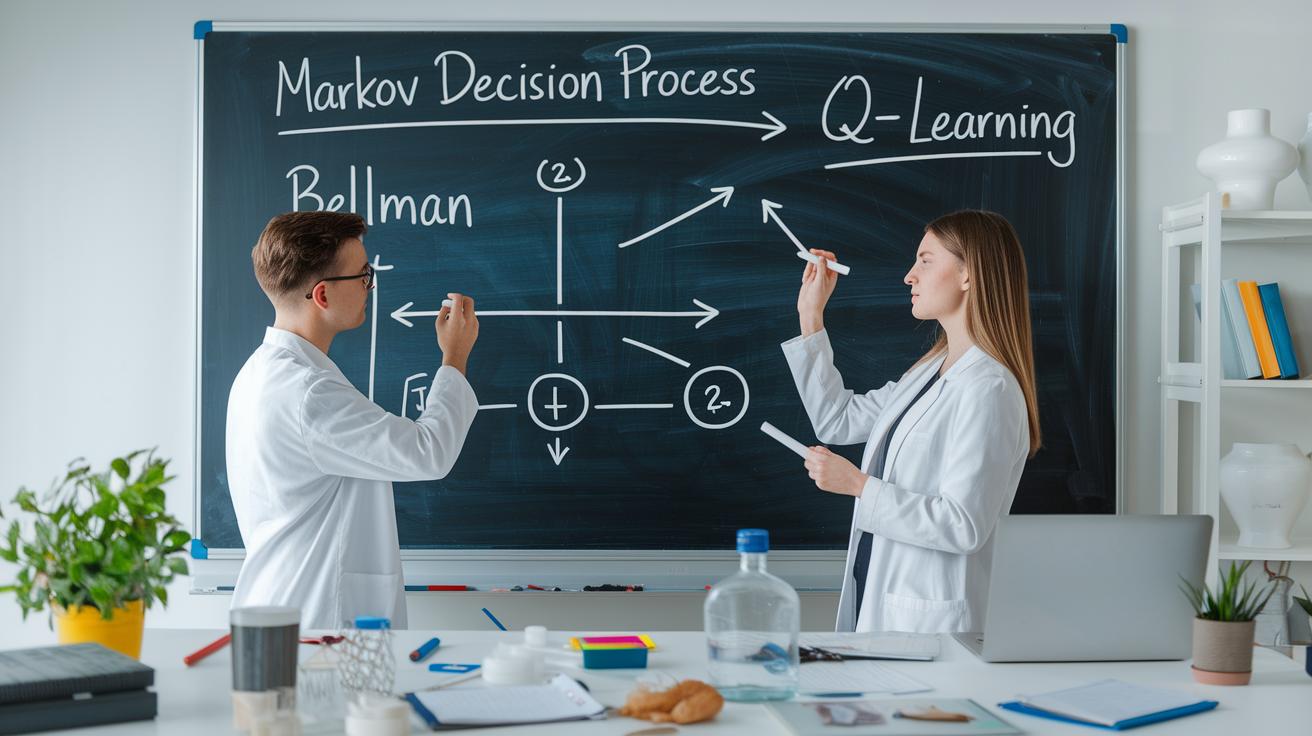
• How does the Markov Decision Process support reinforcement learning?
Think of the Markov Decision Process as a way to map out choices when you’re not sure what will happen next. It’s a bit like planning your strategy in a board game where every move builds on the one before it.
• What role does the Bellman Equation have when it comes to checking and improving policies?
The Bellman Equation helps break future rewards into today’s decisions. It’s like having a step-by-step guide that makes sure each choice sets you up for the best possible outcome.
• How do Q-Learning and Proximal Policy Optimization differ when it comes to fine-tuning actions?
Q-Learning works by directly updating the value of each action, whereas Proximal Policy Optimization takes a more balanced approach to changes, kind of like slowly adjusting the volume knob so everything stays in harmony.
• What sets a GAN apart from a VAE in the world of generative models?
GANs push two networks to compete, which can create very sharp and clear images. In contrast, VAEs work with probability (the chance or likelihood of an outcome) to produce smoother, more blended results.
• How does transformer self-attention compare with traditional RNN methods?
Unlike RNNs that process information one step at a time, transformer self-attention looks at everything all at once. This means it can handle sequences much faster, changing how we deal with data.
• When would you choose frameworks like Spark or Hadoop for ML projects?
When you’re dealing with huge datasets, using big-data frameworks like Spark or Hadoop is key. They let you process lots of information quickly, making sure your models don’t get bogged down.
• How do you spot and handle concept drift in production systems?
To manage concept drift, keep an eye on how your system performs over time. It’s like watching for changes in the weather, you notice when patterns shift and adjust your methods to stay on track.
Behavioral & Soft Skills for Machine Learning Interviews

When interviewers ask you about your experiences, they’re not just looking for tech know-how, they want to see how you explain technical projects and collaborate with others, even when under pressure. One candidate, for example, explained the bias-variance tradeoff (a balance between two types of errors) through a real project story. This not only made the concept clearer but also showed how they adapted when things got challenging.
It helps to back up your answers with real-life examples and a bit of storytelling. Think of times when you navigated a tricky situation and came out stronger on the other side.
-
Describe a challenging ML deployment you managed and explain how you fixed unexpected problems.
Example: "During a high-pressure rollout, I rallied my team to troubleshoot live errors and kept downtime to a bare minimum." -
Talk about how you handle model failures.
Example: "I always review post-mortem reports to spot mistakes and then share what I learned with my team." -
Share a time when clear communication helped your team solve a complex ML problem.
-
Explain how you balance deep technical work with teamwork on critical projects.
Final Words
In the action, this article outlined key areas, from core machine learning interview questions to deep dives into algorithm design, neural networks, and practical coding challenges. We broke down essential topics like supervised and unsupervised learning, model evaluation, and even soft skills needed at the interview table. Each section aims to guide you with clear, bite-sized insights, making prep feel more approachable and fun. Keep exploring, stay curious, and enjoy mastering those machine learning interview questions for your next big opportunity.
FAQ
Q: What resources can help with machine learning interview questions preparation using books, PDFs, and GitHub repositories?
A: The question points to gathering ML interview prep materials. You’ll find curated books, downloadable PDFs, and GitHub collections that offer sample questions and straightforward answers to guide your study.
Q: What do deep learning interview question guides include?
A: The inquiry refers to deep learning interview guides. They typically cover neural network basics, activation functions, backpropagation methods, and model architectures to help simplify advanced topics.
Q: How are machine learning interview questions tailored for freshers usually structured?
A: The question highlights beginner-focused ML queries. These questions concentrate on core topics like algorithm basics, regularization methods, and evaluation metrics to build a sturdy foundation.
Q: What kind of machine learning interview questions appear on coding platforms like Leetcode?
A: The question rephrases ML problems on Leetcode. Such questions involve Python coding problems, decision tree construction, and algorithm implementation to sharpen your practical coding and problem-solving skills.
Q: What is the value of a comprehensive 500-question machine learning interview guide?
A: The question explores comprehensive ML guides. A 500-question collection covers numerous topics—from statistical methods to case studies—providing a broad review and practice resource for interview readiness.