


Have you ever noticed that the Moon sometimes looks bigger or smaller in the sky? It's all because the Moon doesn't travel around Earth in a perfect circle. Instead, it follows a gentle oval path, which means sometimes it feels closer or further away. This natural shift not only changes how big the Moon appears but also influences the ocean tides and even when eclipses happen. In this piece, we'll explore how the Moon moves, what keeps it on track, and why these details are important for space missions and our overall grasp of the universe.
Lunar Orbit: Remarkable Moon Dynamics
The Moon travels along a slightly oval path. This means its distance from Earth isn’t always the same. On the whole, it stays about 384,400 km away, but sometimes it gets as close as roughly 360,000 km and at other times it reaches about 406,000 km. Because its path isn’t a perfect circle, you might notice that the Moon sometimes appears a bit larger or smaller in the sky. It takes around 27.3 days for the Moon to complete one orbit relative to the stars. But since our planet is also moving, the time between full moons, the synodic cycle, is closer to 29.6 days. Fun fact: the Moon rotates on its own axis at the same rate it orbits Earth, which is why we always see the same side. It’s a bit like a clock where both hands move in perfect harmony.
On top of these changing distances and cycles, the Moon zips along at an average speed of 1.022 km/s. This means over the span of a lunar month, it travels nearly 2.4 million km. Its graceful journey is a delicate dance between gravity and momentum, a balance that scientists rely on to understand things like ocean tides and the timing of eclipses. Every little change in its route subtly affects its brightness during events like a “supermoon” or the moment Earth’s shadow falls on it. These precise motions have been essential for planning space missions and continue to inform our exploration of space.
| Parameter | Value | Unit |
|---|---|---|
| Sidereal Period | 27.3 | days |
| Synodic Month | 29.6 | days |
| Average Distance | 384,400 | km |
| Average Orbital Speed | 1.022 | km/s |
Geometry and Tilt of the Lunar Orbit

The Moon's orbit is tilted about 5° relative to the flat plane that most planets follow around the Sun, making its path a bit off-center. It also leans nearly 28° compared to Earth's equator. This double tilt affects how we experience things like lunar eclipses. For example, during an eclipse, the way Earth's shadow covers the Moon changes because even small shifts in that angle can make the shadow look different. Imagine watching an eclipse where one part of the Moon stays lit while another part falls into darkness.
The points where the Moon's path crosses the flat plane are called its nodes, and they slowly shift in a backward direction over an 18.6-year cycle. This gradual movement changes when eclipse seasons occur. If you looked at a detailed diagram of the Moon's path, you'd see that each cycle slightly adjusts the window when eclipses are possible, which in turn affects how often and where we can watch them in our night sky.
Lunar Orbit Cycles and Phases
The Moon goes through distinct cycles that shape its changing look in our sky. First off, there’s the sidereal cycle, which takes about 27.3 days. That’s the time it needs to orbit Earth when we think of far-away stars. Then, there’s the synodic cycle, lasting roughly 29.6 days. This cycle marks the time between the same phases of the Moon, like from one full moon to the next. It’s a bit like a gentle clock ticking away, where each phase flows into the next with an understandable, steady rhythm.
Then we have two shorter cycles that add extra detail to how we see the Moon from Earth. The anomalistic month lasts around 27.55 days and deals with slight changes in the Moon’s oval-shaped orbit (think of it as a little wobble in its path). The draconic month, on the other hand, is about 27.21 days long and tweaks for a subtle shift in the Moon’s orbital nodes (those are the points where its orbit crosses the ecliptic). These shorter cycles play a key role in timing eclipses, ensuring that when Earth’s shadow falls on the Moon, it happens in a choreographed cosmic dance.
Transfer Trajectories and Lunar Orbit Insertion
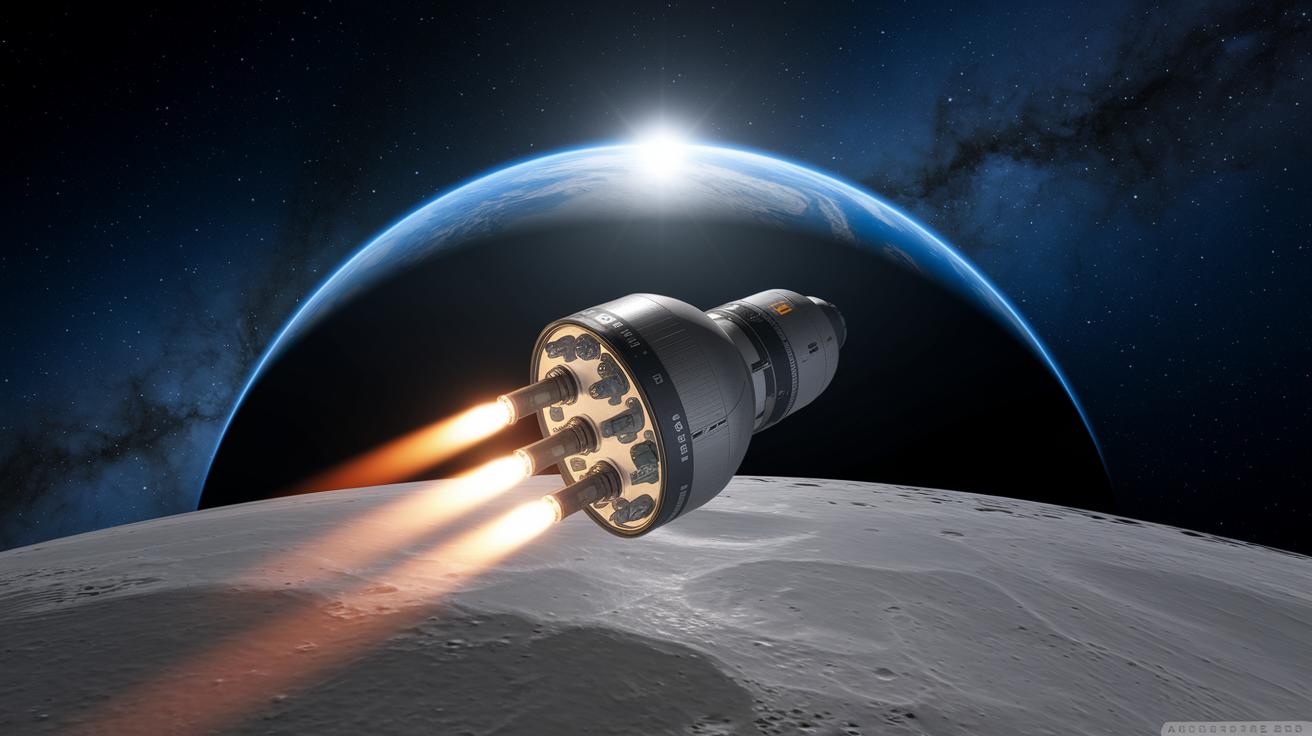
When planning a mission to the Moon, the journey starts by breaking free from Earth’s familiar gravitational pull. The process begins in a stable orbit around our planet, where the spacecraft gets a boost of about 3.2 km/s in a maneuver known as a trans-lunar injection (a controlled push that sets it on a new path). This extra speed helps the spacecraft leave Earth’s usual orbit and head toward the Moon while still being gently tugged by Earth’s gravity during its three-day coast.
As the spacecraft nears the Moon, it needs a final engine burn to shift its path into an orbit around the lunar surface. This step, called the lunar orbit insertion burn, requires a change of about 0.9 km/s. A well-timed burn settles the spacecraft into a steady orbit at around 100 km above the Moon, ready for further experiments or operations.
Here are the key steps in a lunar mission:
- Achieve low Earth orbit parking
- Execute the trans-lunar injection burn
- Coast on the way to the Moon
- Perform the lunar orbit insertion burn
These planned moves show just how critical it is to balance energy and timing in our Moon missions. It’s a careful dance with gravity and speed that lays the groundwork for exciting future projects like the lunar gateway.
Historical Missions Mapping the Lunar Orbit
Back in 1966, Luna 10 made history as the very first man-made satellite to circle the Moon. This bold mission set the stage for how we understand the Moon’s journey in space. Thanks to Luna 10, scientists gathered key details about the Moon's pull and how objects move around it. Not long after that, NASA’s Apollo missions stepped in, orbiting the Moon at about 110 km above its surface and giving us even more insights. For instance, the Apollo command modules carried out careful maneuvers to settle into their orbits, moves so precise that you can see the details in their lunar module profiles. These achievements not only delivered crisp images of the Moon’s face but also helped us fine-tune our ideas of how spacecraft balance between Earth’s pull and the Moon’s own gravity.
Then, missions like Clementine in 1994 pushed our knowledge further by charting the Moon’s surface and spotting subtle changes in its terrain. After that, the Lunar Reconnaissance Orbiter in 2009 built on these discoveries with super-clear images and better measurements of odd gravitational spots (areas where gravity behaves a bit differently). Every mission added a new layer of evidence that guided the design of future spacecraft and shaped mission goals for lunar travel. All these milestones together changed our grasp of how objects orbit the Moon, and they continue to inspire today’s explorers who dream of expanding human footprints in space.
Future Strategies for Sustained Lunar Orbits

New plans for moon missions are opening up a whole new view of how we can stay active around our lunar neighbor. For example, Artemis will send Orion into a special orbit called a near-rectilinear halo orbit. In simple terms, this means Orion will swing far away from the Moon, up to about 70,000 km at its farthest point, and come close, about 3,000 km, at its nearest. This clever orbit acts like a steady base for both astronauts and robots. Plus, every 21 days the spacecraft does small engine burns to tweak its path and keep everything balanced and on track. Have you ever wondered how space missions keep their steady path? It turns out these adjustments are key to long-term lunar studies and crewed flights.
NASA is also planning to launch tiny satellites, often called smallsats, into lower orbits around the Moon, usually between 50 km and 100 km above its surface. Think of these satellites as a tight-knit data network that helps with constant communication, detailed observation, and spotting areas of interest. Combining this low lunar orbit with the near-rectilinear design gives us more flexible options for operations around the Moon. This refreshing approach not only makes mission planning more adaptable but also helps us learn more about the Moon’s environment as we get ready to work there for longer periods.
Final Words
In the action of tracing the Moon’s dance, we explored how an elliptical path and tilts shape its course and cycles. We followed from transfer burns that set a course from Earth to the Moon to historic missions that refined our approach.
Each section offered clear snapshots of orbital mechanics, timing, and mission strategies. Stay inspired as we continue our watchful gaze on the lunar orbit.
FAQ
What is the lunar orbit distance?
The lunar orbit distance describes the average path of the Moon around Earth, measuring roughly 384,400 km with variations from about 360,000 km at perigee to 406,000 km at apogee.
What is meant by “lunar orbit today”?
The term “lunar orbit today” refers to the current tracking and observation of the Moon’s orbital position and movement, often shown through live data displays by space agencies.
How does NASA track or study the lunar orbit?
NASA studies the Moon’s orbit using precise measurements and computer models to capture its elliptical shape, speed, and phases, thereby supporting mission planning and scientific research.
What does a Moon orbit animation show?
A Moon orbit animation illustrates the elliptical path of the Moon around Earth, highlighting its changing distances and speeds, which makes the orbital mechanics accessible and engaging.
What is the Lunar Orbit band?
The Lunar Orbit band is a musical group whose name draws inspiration from the Moon’s journey around Earth, blending a fascination with space and creative expression.
What is a lunar orbit satellite?
A lunar orbit satellite is a spacecraft placed around the Moon for scientific observations, communication, or mapping, following similar orbital principles as satellites around Earth.
What does “lunar orbit live” mean?
“Lunar orbit live” commonly refers to real-time tracking of the Moon’s current orbital position using live data feeds, providing immediate insight into its movement and phase.
What is lunar orbit altitude?
Lunar orbit altitude indicates the height of an orbiting spacecraft above the Moon’s surface, often maintained around 100 km in low lunar orbits to allow detailed observation and safe operations.
Is the Moon’s orbit 27 or 29 days?
The Moon’s orbit is measured as 27.3 days for a sidereal period relative to the stars and about 29.6 days for a synodic cycle, which accounts for its phases as seen from Earth.
Does the Moon follow the same path every night?
The Moon does not follow the same path each night; its orbital motion and the tilt of its trajectory cause it to shift gradually across the night sky over time.
What happens every 18.6 years in the lunar orbit?
Every 18.6 years, the lunar nodes complete a full cycle of regression, influencing eclipse timing and altering the geometry of the Moon’s path relative to Earth’s equator.
Why doesn’t the Moon rotate?
The Moon doesn’t rotate independently because its rotation is synchronized with its orbit, causing the same side to always face Earth as a result of long-term gravitational locking.