


Have you ever wondered how the Moon seems to have its own atmosphere even though it’s nearly a vacuum? Some scientists say this thin layer of atoms drifting above the dusty surface might change how we think about space. Although this exosphere (a very light layer of gas) isn’t like the air we breathe on Earth, it holds secrets about powerful cosmic forces and energy flows.
In this article, we take a closer look at the Moon’s ever-changing envelope. Get ready to discover surprising details about these tiny particles and how they move through almost nothing at all.
Lunar Atmosphere: Radiant Space Facts
The Moon doesn’t have a thick, protective atmosphere like Earth. Instead, it sports an exosphere, a super-thin layer where air is almost missing (about 10⁻¹² torr at the surface). Tiny atoms like oxygen, sodium, argon, helium, and neon float above, released from the Moon’s dusty, loose soil called regolith.
Imagine an atmosphere so thin that each particle travels on its own, like a lone traveler without a continuous blanket of air connecting them. This neat idea helps us understand what really makes up the Moon’s outer layer.
As you move away from the surface, the number of atoms drops quickly, from roughly 100 to 10,000 per cubic centimeter. Unlike Earth’s multi-layered air, these atoms move along simple curves, creating a delicate and shifting display of gas. Different parts of this exosphere show slight changes in how many atoms are there and how they drift around.
Researchers use satellites to measure these changes, which reveal that the number of atoms decreases exponentially with height. And don’t forget the constant push of the solar wind, which stirs the exosphere and sometimes lifts particles into higher orbits.
There’s also a process called regolith suspension that helps explain how atoms get knocked off the surface in the first place. Observations of these sparse layers remind us that even in near-vacuum conditions, there’s a surprising complexity at work. This ever-changing lunar exosphere continues to be an intriguing puzzle for those studying our closest celestial neighbor.
Sources and Formation of the Lunar Atmosphere

Recent studies show that the Moon isn’t as lonely as we once thought. Over billions of years, it has slowly picked up fragments of Earth’s air, things like oxygen and nitrogen. Scientists believe that this happened when tiny atoms were carried off by the solar wind and influenced by Earth’s magnetic field. Imagine Earth's air particles being swept along by invisible forces and gently landing on the Moon.
Micrometeorites, or tiny space rocks, play a bigger part in this story than you might expect. When these little rocks hit the lunar surface, they knock atoms loose from the Moon’s dusty soil. This process, called sputtering, helps explain why the Moon’s feeble atmosphere contains particles that wouldn’t naturally be there. At the same time, the lunar soil is releasing small amounts of gases like helium, argon, and radon. Recent experiments show that these gases are steadily added to the Moon’s atmosphere, hinting that there’s more going on than just Earth’s influence.
New techniques that study vapor around the Moon add even more clues. They challenge old theories based mostly on Apollo-era rock samples. It turns out that gases escaping from the Moon come not only from micrometeorite impacts but also from ongoing interactions between the Moon and the vastness of space. This fresh, evolving view of how the Moon’s atmosphere forms makes us rethink what we know about the air and space in our own cosmic neighborhood.
Solar Ultraviolet and Day-Night Dynamics in the Lunar Atmosphere
Ultraviolet light from the sun does some pretty cool things to the Moon's thin atmosphere. When this light hits atoms coming off the lunar surface, it knocks off electrons, charging the particles. Once these atoms are charged, they can jump up to about one mile above the surface during the daytime. It’s a bit like a tiny dust particle suddenly picked up by a gust of wind.
At night, the scene changes. The atoms grab electrons from the solar wind, lose their charge, and drift back down toward the Moon's surface. This back-and-forth charging creates noticeable shifts in the Moon's exosphere over a 24-hour cycle, giving it a layered look.
Key points include:
- Solar wind helps remove electrons from the atoms.
- The changing particle levels create layers above the surface.
- Surface particles get freed and lifted in the process.
These processes paint a dynamic picture of how the Moon's atmosphere evolves throughout the day and night.
Insights from Missions: NASA Probe Findings on the Lunar Atmosphere
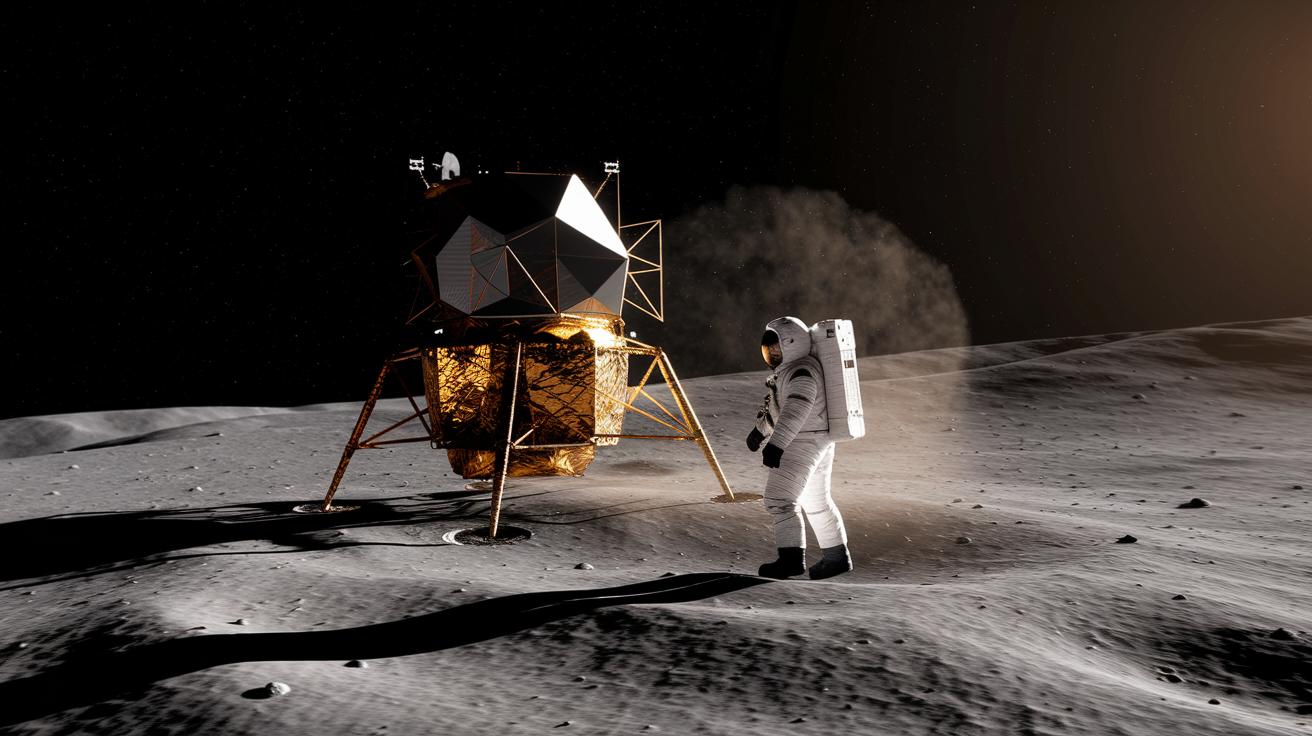
Early missions to the Moon helped us get a sneak peek into the Moon's thin covering of gas. Back in the Apollo days, the lunar module carried basic gear to detect this atmosphere. These early tools only gave us a rough look at the scattered gas, but they sure sparked a lot of curiosity and led to more detailed future explorations.
Then came Lunar Prospector, which really upped the game by mapping out where argon atoms were hanging around using a mass spectrometer (a tool that measures tiny particles). This method helped scientists grasp how these argon atoms were spread out and how dense the gas was in different places.
Later, LADEE made a big splash between 2013 and 2014 by measuring sudden increases in the number of particles, anywhere from 100 to 10,000 per cubic centimeter. It even picked up important ingredients like sodium and potassium. Imagine it like catching a sudden burst of energy from the Moon’s hidden atmosphere.
NASA’s LRO added another piece to the puzzle with its ultraviolet spectrometer, which tracked how dust and plasma (charged particles) interacted over time. Its readings showed small changes in the Moon’s exosphere that were tied directly to events happening on the lunar surface. Meanwhile, Chandrayaan-1’s CHACE instrument found hints of water vapor near the Moon’s poles, suggesting that the Moon’s atmosphere is even more complex than we once thought.
Key mission insights include:
- Apollo missions with early exosphere detectors
- Detailed argon mapping by Lunar Prospector
- Density spikes and key elements uncovered by LADEE
- Ongoing dust-plasma interaction tracking by LRO
- Trace water vapor picked up by Chandrayaan-1
Implications for Future Exploration and the Lunar Atmosphere
New plans for lunar outposts include sensors in the exosphere that will help fine-tune thrusters in the Moon’s near-vacuum. Imagine a base where every little sensor catches even the faintest puff of gas, almost like a mini weather station in space.
Next, future research will chart where helium-3 is found alongside cool spots that trap cold air and zones where dust and plasma mix. Think of these charts like treasure maps, pointing out both valuable resources and hidden dangers near the Moon’s thin gas layer. Already, data from Lunar Gateway experiments help scientists improve models that show how the surface and plasma interact, which then guides safe habitat design.
Researchers are also set to use direct fume capture techniques. This means they can track how released gases play with the lunar environment. A big part of this is learning how dust (regolith) gets lifted into the air, much like tiny particles drifting above the ground and potentially affecting landers and shelters.
Altogether, understanding the Moon’s thin atmosphere not only sparks new insights for exploration but also changes the way we plan for future missions and keep habitats secure.
Final Words
In the action, we explored the striking features of the Moon’s near-vacuum exosphere, discussing how solar light and micrometeorite impacts influence its ever-changing gas patterns. We looked at past mission data and recent probe insights that track shifts in particle density and composition.
This analysis sparks curiosity about how these insights might guide future lunar outposts and tech tests. Each step forward brings a fresh perspective, lighting the way as we expand our knowledge of the lunar atmosphere.
FAQ
What is the Moon’s atmosphere called?
The Moon’s atmosphere is known as an exosphere, a nearly vacuum-like layer where particles are so sparse they follow individual, non-colliding paths.
Is there wind on the Moon?
The Moon shows almost no wind because its sparse exosphere lacks the dense, interacting particles needed to create the type of wind we experience on Earth.
How does Earth’s atmosphere relate to the Moon?
The Moon captures fragments of Earth’s atmosphere through interactions with the solar wind and Earth’s magnetic field, linking the two even in the sparse vacuum.
How does the Moon’s atmosphere compare to Earth’s?
The Moon’s exosphere is extremely thin compared to Earth’s dense troposphere; while Earth has a layered, continuous air mass, the Moon has only scattered particles.
What is the Moon exosphere made of?
The Moon exosphere primarily consists of trace atoms such as sodium, helium, argon, and oxygen released from its surface, making up a dynamic but rarefied gas layer.
What could a lunar atmosphere PDF contain?
A lunar atmosphere PDF would detail studies on exosphere properties, composition measurements, the impact of solar radiation, and data from various lunar missions.
What are the typical percentages in the Moon’s atmosphere composition?
The composition is mostly trace elements with sodium, helium, and argon dominating, while oxygen also makes up a minor fraction released from the lunar surface.
What interesting facts exist about the lunar atmosphere?
Key facts include its near-vacuum state, diurnal changes from solar exposure, replenishment by micrometeorite impacts, and its stark contrast to Earth’s thick atmosphere.
Is lunar water drinkable?
Lunar water, found as vapor or frozen deposits in shadowed regions, is not confirmed drinkable without proper purification due to potential contaminants.
What did Harrison Schmitt discover on the Moon?
Harrison Schmitt uncovered mineral samples and signs of water vapor in lunar rocks, offering insights into the Moon’s geology and hints of volatile substances.
Why doesn’t the Moon have a significant oxygen atmosphere?
The Moon lacks a substantial oxygen atmosphere because its weak gravity cannot retain large amounts of gas, and its surface processes release only trace amounts of oxygen.