


Have you ever thought about the universe being made of tiny pieces that change the way we see matter? New breakthroughs in physics are challenging our old ideas. For example, researchers are looking closely at dark energy (the mysterious force that makes the universe expand) and even a special kind of matter that acts like a solid and a liquid at the same time.
Scientists are picking up very faint signals when black holes crash together. These tiny clues sometimes confirm what we believed for years and other times make us question those ideas. In this article, we explore some surprising discoveries that mix classic theories with new findings to help us understand the cosmos a little better.
Physics Breakthrough Discoveries: Comprehensive Recent Advances
Science has been buzzing with new breakthroughs that are changing how we see the universe. In 2024, space surveys noticed that dark energy's key number, w, was above -1. This small but important detail hints that dark energy might be losing some of its mysterious strength, shaking up our old ideas about the universe speeding up.
In January 2024, researchers created a supersolid, a state of matter that combines the neat order of a crystal with the smooth, free flow of a superfluid. Think of it like water that still keeps its shape, almost like a frozen river with endless possibilities. This discovery is opening up exciting new ways to work with quantum materials and deepening our understanding of nature’s building blocks.
Mid-2024 brought fresh insights into quantum theory too. Scientists refined models of quantum geometry, suggesting that spacetime might be made of tiny, separate chunks instead of one smooth fabric (imagine it as the tiniest pixels that come together to form a big picture). This idea points to a fascinating blend where deep theory meets practical measurement.
LIGO–Virgo experiments also scored big by detecting five black-hole mergers with extremely sensitive measurements (down to 10⁻²³). These results give us solid proof of Einstein’s theory of relativity, showing just how powerful high-energy experiments can be. Curious to see where this journey leads? For more on the latest breakthroughs, check out the science progress at https://fairlygreat.com?p=179.
Quantum Paradigm Shift in Physics Breakthrough Discoveries

Quantum theory is getting a real makeover. In studies from 2024, scientists discovered hints that spacetime might be made up of tiny bits, think of it like a mosaic of small building blocks. Even the tiniest parts could affect how particles behave, which might totally change how we see gravity and motion.
Experiments in quantum entanglement are also stepping up their game. Researchers managed to create photon links that stay strong over 50 km of fiber. One test even showed entangled photons keeping their delicate state across an entire city block, making us rethink what separation really means. This breakthrough brings a fresh wave of hope for building tougher, quantum-based communications.
At the same time, advancements in quantum computing are reshaping how we handle data. New techniques to fix errors in qubits (the basic units of quantum information) are helping keep information stable despite tiny disturbances. In October 2024, a bold idea was put forward: what if we treated information as fundamental as mass or energy? This new view signals a shift in the quantum world, promising exciting developments both in theory and practical applications. For more details on these innovations, check out https://fairlygreat.com?p=306.
Particle Accelerator Insights in Physics Breakthrough Discoveries
Picture a huge machine that crashes tiny particles together at almost the speed of light, opening hidden windows into the universe. Back in 2012, the LHC, a massive collider at CERN, found the Higgs boson at 13 TeV. This discovery proved that the Higgs field (an invisible force that gives particles their weight) really works, much like finding the missing piece in a challenging puzzle.
Now, CERN’s ongoing experiments are taking measurements to a whole new level. Imagine if a particle collider could measure with less than a one percent error margin, that’s exactly what these tests are doing. This leap in accuracy helps us understand those blink-and-you-miss-it particle interactions in far greater detail.
Meanwhile, fresh technology in detectors is getting scientists really excited. New silicon pixel detectors and super-fast timing modules are making it possible to capture high-energy collisions with amazing clarity. Think of it like upgrading from a fuzzy, old photo to a crisp high-definition image, where every detail shines through.
Together, these improvements in both the accelerator’s performance and the detection tools are turning tiny particle events into big stepping stones. It’s a journey that brings us ever closer to understanding the most basic building blocks of nature.
Gravitational Waves Findings and Physics Breakthrough Discoveries

Gravitational waves are tiny ripples in space that have totally changed how we study the universe. It all began in 2015 when LIGO first picked up these waves, just as Einstein had predicted. Picture a whisper so soft that you need super-sensitive tools to detect it, like trying to hear a secret in the middle of a bustling stadium. One experiment even picked up waves from two black holes colliding, a signal so faint it’s like watching a single leaf flutter in a wild storm.
Today, observatories like Advanced LIGO and Virgo catch these subtle signals on a regular basis. They track cosmic events like merging black holes and neutron stars, giving us fresh insights into the dynamic drama of space. And here’s the cool part: scientists now watch light and other signals at the same time as gravitational waves. By putting all these clues together, they build a clearer picture of these massive cosmic smash-ups.
The magic behind catching these whispers lies in a technique called laser interferometry (using lasers to measure tiny changes), which works like a finely tuned ear for the universe. Looking ahead, researchers hope that gravitational wave data can be mixed with studies on the cosmic background (the afterglow of the Big Bang) to shine even more light on our universe’s early days. All these breakthroughs are opening up a brand new window into the vast, ever-changing cosmos.
Dark Matter and Dark Energy Revelations in Physics Breakthrough Discoveries
Dark matter makes up about 27% of the universe’s mass and energy, but we haven’t seen it directly yet. Scientists are piecing together clues by watching how galaxies move and group together, hoping to uncover these mysterious particles. Think of it like solving a puzzle where a quarter of the pieces are missing, yet those hidden pieces shape the whole picture.
Meanwhile, researchers are paying close attention to dark energy. In large surveys from 2024, they found hints that its strength might change over time. This new evidence is challenging our old ideas, as it suggests the force behind the universe’s speeding expansion might not be constant. They’re now comparing data from different times, almost like looking through snapshots of the cosmos at various moments.
At the same time, lab teams are exploring what’s known as vacuum energy. They’re trying to fix the gap between the value predicted by theory and what experiments show for the cosmological constant (a number that tells us about the energy in empty space). This hard work is key to understanding the hidden forces that shape our universe.
Theoretical Model Progress in Physics Breakthrough Discoveries
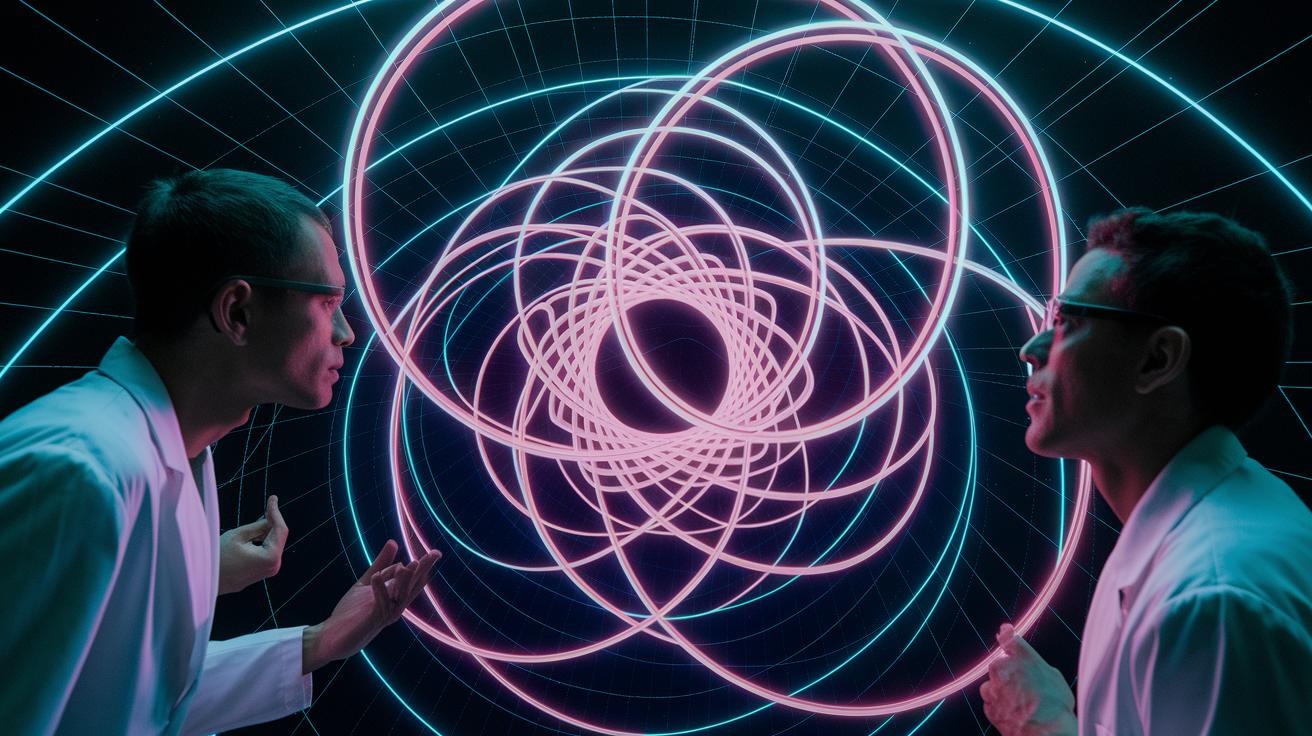
In 2024, string theory research took a bold leap. Scientists are now exploring ideas that stretch into more than ten dimensions. Imagine a cosmic dance where forces twist and mix in ways that go far beyond our everyday space, like putting together a puzzle that unveils hidden patterns. They’re working hard to merge familiar physics ideas into one clear picture that fills in the big gaps.
Not long ago, new models suggested that gravity might not be an independent force at all. Instead, think of gravity as the outcome of a network of tiny bits of quantum information (the small pieces that build up everything around us) working together. It’s a bit like a symphony where every instrument matters only when it plays its part.
Recent advances in loop quantum gravity and holographic dualities are also opening up fresh ways to look at quantum gravity. Alongside emerging methods like gauge theory (approaches that explain how forces operate), these breakthroughs are helping us connect the very small parts of nature with the grand order of the cosmos.
Astrophysical Frontier Innovations in Physics Breakthrough Discoveries
The James Webb Space Telescope launched on December 25, 2021, and it’s been changing how we look at the skies. It picks up infrared light (like a secret glow) between 0.6 and 28.5 micrometers, capturing detailed snapshots of far-off exoplanets. Imagine looking into a vast, glittering cosmic ocean where every tiny dot hints at a world waiting to be discovered.
NASA’s DART mission, which gently nudged the asteroid Dimorphos off course on September 26, 2022, showed us that we can actually protect our planet by redirecting space rocks. This clever move teaches us that with a pinpoint impact, we hold the potential to steer dangerous objects away and keep Earth safe.
There’s more excitement in space today thanks to smarter, cost-effective launch methods. SpaceX’s reusable rockets, for example, have trimmed launch expenses by about 30 percent. Lower costs mean more scientists can explore space, fostering a spirit of discovery that expands our understanding of the universe, one bold mission at a time.
Final Words
In the action, we explored physics breakthrough discoveries that shook up our view of nature. We saw how cutting-edge research in dark energy, gravitational waves, and particle accelerators sharpens our understanding of the cosmos. Quantum advances and theoretical leaps add fresh details, while astrophysical innovations broaden our research horizons. Each breakthrough fuels our curiosity and sets the stage for even more exciting progress. Stay tuned as each stride pushes our science forward with an inspiring blend of innovation and insight.
FAQ
What are some major physics breakthrough discoveries?
The physics breakthrough discoveries highlight advances like recent dark energy measurements hinting at gradual weakening, the creation of a supersolid phase, refined quantum geometry models, and gravitational wave detections that reinforce relativity.
What recent physics discoveries have captured attention in the 21st century?
Recent developments include astrophysical surveys outlining dark energy, high-energy collision insights from particle accelerators, improved gravitational wave detections, and innovative quantum experiments that are reshaping our understanding of nature.
What are some of the greatest discoveries in physics?
Some of the greatest discoveries combine results from gravitational wave detections, confirmation of the Higgs field, and emerging quantum models that propose a discrete nature of spacetime, which all deepen our grasp of the universe.
What is the Physics Breakthrough Prize?
The Physics Breakthrough Prize recognizes researchers for transformative work, awarding achievements that confirm key theoretical predictions through precise measurements, such as those observed in binary black-hole mergers.
What are the biggest unanswered questions in physics?
Key unanswered questions involve understanding the true nature of dark energy, reconciling quantum mechanics with gravity, and clarifying how quantum information theories may explain the fabric of the cosmos.
What is the latest discovery in physics expected in 2025?
The latest predicted advances include refined quantum models, enhanced particle accelerator data, and fresh astrophysical insights, all of which aim to clarify mysteries surrounding dark matter, dark energy, and spacetime structure.