


Have you ever pictured a space robot figuring things out on its own? Today, AI helps smart rovers make real-time decisions. They scan the terrain and pick safe paths when messages from Earth take too long. At NASA, these tools let machines dodge surprises quickly, which speeds up missions and adds flexibility. In our post, we explore how AI is boosting success and making travel between planets smoother and more efficient.
The Role of Artificial Intelligence in Contemporary Space Missions
Artificial intelligence is changing space travel by letting smart rovers make decisions on their own instead of waiting for orders from Earth. Modern systems help machines check out terrain details, plan tasks quickly, and handle communication delays. With onboard decision-making, missions run more smoothly and effectively, even when Earth is really far away.
At NASA, AI is built into many tools that let rovers find their way through tricky terrain without needing constant instructions. This shift means that vehicles like the Perseverance rover can figure out their power limits, deal with unexpected obstacles, and adjust their routes as needed. Take, for example, Perseverance’s ability to operate on its own (see the NASA Mars Rover); it marks a big change from old mission methods by giving these robotic explorers a smart, responsive edge for interplanetary travel.
- AEGIS: This tool gathers and interprets environmental data so rovers can quickly spot important features and choose the best path.
- Enhanced AutoNav: It processes sensor information in real time, supporting the rover’s ability to navigate by itself and reducing delays caused by back-and-forth communication with mission control.
- Terrain-relative guidance: This system constantly checks the ground for hazards and helps the rover adjust its course safely across different surfaces.
These improvements show that AI not only helps cut down on delays and power issues but also boosts overall mission success. By using onboard decision-making, space missions become more flexible and efficient, paving the way for tougher and more successful journeys beyond Earth.
AI-Powered Analytics for Celestial Data Processing
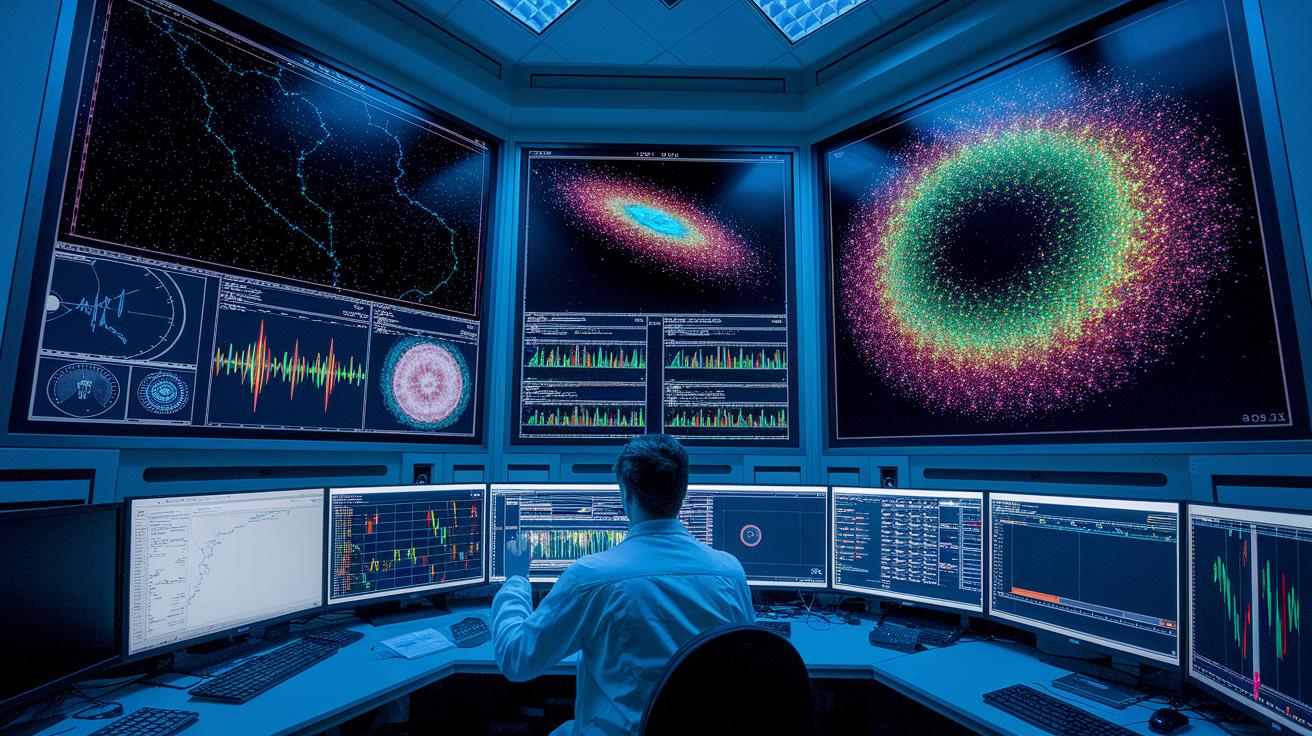
Astronomy now faces a flood of data from telescopes, satellites, and sensor arrays. Imagine sorting through thousands of pictures to find that one rare shot, researchers do just that, trying to spot faint signals buried in a lot of background noise. To handle these big-data challenges, we need tools that can quickly process and organize messy, unstructured information.
Scientists are now using clustering algorithms and fusion methods to tame this complexity. In basic terms, machine-learning groups together similar signals, turning raw numbers into clear patterns. For example, projects like SensorWeb blend different sensor feeds to keep an eye on Earth’s environment, while orbital algorithms help create Global Seasonal Mars Frost Maps. These astroinformatics techniques transform chaotic data into insights we can really use.
Deep neural models, which are smart computer programs, play a key role in discovering exoplanets and detecting odd events in satellite data right away. They sort through stellar signals, picking out potential exoplanets from cosmic noise, and they even flag unexpected data spikes. Picture an algorithm quietly noting an unusual surge in data that might signal a new exoplanet, this innovative approach makes discoveries faster and expands our understanding of the universe.
Autonomous Robotics and Intelligent Rovers on Planetary Surfaces
Robotic explorers aren’t waiting for instructions from Earth anymore. Thanks to onboard computers and smart sensor systems, they can now make decisions on their own in real time. This shift marks a breakthrough in how we explore space.
NASA’s Perseverance rover uses a method called terrain-relative guidance, along with tools like lidar (a light-based mapping tool) and stereo vision (giving it 3D sight), to understand its surroundings. When unexpected obstacles pop up, imagine dodging a scattered field of Martian rocks like a seasoned driver, it can quickly change its path.
ESA’s ExoMars Rosalind Franklin rover takes a unique approach by offloading some learning to an onboard AI lab from the European Astronaut Centre. It runs custom algorithms (step-by-step instructions) to study local rock patterns and pick the best spots for sampling, much like a smart explorer figuring out the most intriguing parts of the landscape on its own.
By cutting back on Earth-based commands, these innovations help the rovers respond fast to dangers and adjust their routes seamlessly. This makes managing missions on distant worlds a lot smoother.
Future AI Applications in Deep Space Expeditions and Habitat Simulation

Next-gen AI is changing how we keep astronauts safe and train crews for missions far from Earth. Engineers can now use computer models to recreate the conditions on the Moon and Mars. This means they can check life-support systems in a virtual habitat that feels almost real. And with virtual reality training that uses trial and error (reinforcement learning), space crews can practice walking outside their spacecraft, getting a taste of the physical challenges of space.
Smart control systems are set to make space travel smoother too. Imagine a system that helps with docking, booster control, and even divvying up resources among different parts of a mission. These predictive models are like helpful roadmaps, guiding crew transport and remote operations even when there’s a delay in communication. The way this technology balances everything means that even deep-space missions can run reliably, making sure every part of the mission works together.
Deep neural networks, the kind of computer programs that learn by example, will also push the boundaries of exoplanet research. NASA, for instance, is planning to use these models to check out new planets and spot odd signals in streams of space data. They sift through mountains of sensor readings so scientists can quickly zero in on interesting exoplanet candidates and notice unusual patterns that might lead to fresh discoveries. It’s an exciting step that could give us sharper, quicker insights into hidden corners of the universe.
Ethical Frameworks for Responsible AI in Space Programs
At NASA, a government order sets out clear rules about how to use AI responsibly. The agency makes sure that every AI tool is fully accountable, easy to trace, and always under human watch. This means that critical missions, like those involving self-learning rocket guidance or orbital station controls, are never fully automated, humans stay in charge.
Over at ESA, they show a similar commitment. Their AI Lab uses human-in-the-loop checks to confirm that any automated decisions, such as those for the lunar Gateway or surface missions, follow international space laws. They review every step to ensure that technology helps our space missions while keeping safety front and center.
By tying ethical checks into space programs, agencies keep missions safe and maintain public trust. This way, as AI helps push the boundaries of what’s possible, human insight remains at the helm of space exploration.
Final Words
In the action, the article showed how artificial intelligence and space exploration work hand in hand on today's missions. We explored NASA’s innovative systems, like Perseverance’s autonomous operations, and ESA’s smart robotics guiding off-world ventures.
The post unpacked how sensors, machine learning, and smart control systems help tackle space’s challenges while paving the way for off-world habitats.
This lively mix of AI and space breakthroughs leaves us excited about what comes next.
FAQ
What does “artificial intelligence and space exploration pdf” refer to?
The term refers to downloadable documents that explain how AI supports space missions, describing systems like NASA’s autonomous navigation tools and advanced data analytics used for mission planning.
What does an “AI in space exploration PDF” offer?
This PDF provides documented cases of AI integration in space, illustrating examples such as autonomous rover systems, onboard data processing, and decision-making tools that boost mission efficiency.
What does the history of AI in space exploration cover?
The history covers early AI implementations that paved the way for modern systems, highlighting a shift toward onboard decision-making that now empowers mission planning and autonomous rover operations.
What does NASA generative AI guidance involve?
NASA generative AI guidance outlines safe and responsible practices for using AI in missions, ensuring systems like autonomous navigation are managed with strong human oversight and reliable performance.
What is meant by artificial intelligence in space?
Artificial intelligence in space refers to the use of smart systems that help with tasks like making onboard decisions, analyzing vast datasets, and guiding robotic explorers in challenging environments.
What benefits does AI bring to space exploration?
AI provides benefits like quick onboard decision-making, efficient data processing, and increased mission adaptability, all of which help reduce the reliance on Earth-based controls during space operations.
What are some examples of NASA AI projects?
NASA AI projects include systems like AEGIS, Enhanced AutoNav, and terrain-relative guidance. These projects enable rovers to operate autonomously and improve mission planning and safety through smart analytics.
What are the disadvantages of AI in space exploration?
The disadvantages include a heavy reliance on automated systems and the challenges of ensuring consistent performance in extreme space environments, which can occasionally affect critical mission operations.
How is AI being used in space exploration?
AI is used for autonomous rover navigation, real-time anomaly detection, and analyzing large volumes of sensor data, which together enhance safety and boost the performance of mission-critical systems.
Is NASA allowed to use AI in its missions?
NASA is allowed to use AI as long as it follows established government guidelines that emphasize human oversight, accountability, and traceability in the deployment of mission-critical systems.
When was AI first used in space exploration?
The use of AI in space exploration began decades ago with early systems that assisted with basic navigation and data processing, setting the stage for the more advanced AI technologies in use today.
What does Bill Gates say about artificial intelligence?
Bill Gates has commented on AI by highlighting both its potential benefits and risks, urging a balanced approach that maximizes its advantages while addressing possible societal impacts.