


Ever dreamed of calling the moon your home? Imagine a small colony out there that could completely change how we think about life in space.
Scientists and engineers are already sketching out ideas for safe, comfortable habitats, even with the moon’s tough environment. With missions on the horizon and teams from around the globe pitching in, these projects might also unlock new ways to get clean energy and valuable resources to help us thrive off Earth.
This daring endeavor is paving the way for real steps toward living in space and could transform our future in unexpected ways.
Comprehensive Overview of Lunar Colony Concepts and Initiatives
A lunar colony isn’t just a simple base, it’s a blueprint for the next giant leap for humankind. It all began with Gui Trotti’s initial design, which built on a NASA-sponsored study from several Texas universities. That work set the stage for creating safe, livable habitats on the Moon, where the environment is as harsh as it is mysterious.
NASA’s recent moon mission plans have sparked exciting ideas like the Artemis program, which aims for crewed landings on the Moon in the mid-2020s. Included in these plans is the lunar gateway, an orbiting station that will help support deeper space exploration. Did you know that NASA’s Artemis program might completely change how we think about living on another celestial body by building essential waystations beyond Earth?
International teams are also on board. Missions like India’s Chandrayaan, China’s Chang’e, and Japan’s SLIM are adding crucial insights, while contributions from the ESA deliver extra technical know-how. Plus, private companies like SpaceX and Blue Origin are pushing fresh ideas into the mix. Together, these efforts break new ground and challenge what we once thought was possible.
A lunar colony could do more than extend our reach in space, it might also unlock valuable resources like helium-3, which could lead to clean energy breakthroughs, and provide continuous solar power near the Moon’s poles. The abundant lunar dust, known as regolith, could even serve as building material for future structures. In many visions of the future space economy, these resources are seen as key drivers for growth off Earth, blending scientific adventure with concrete benefits for life beyond our planet.
Moon Base Engineering: Habitat Design and Structural Requirements
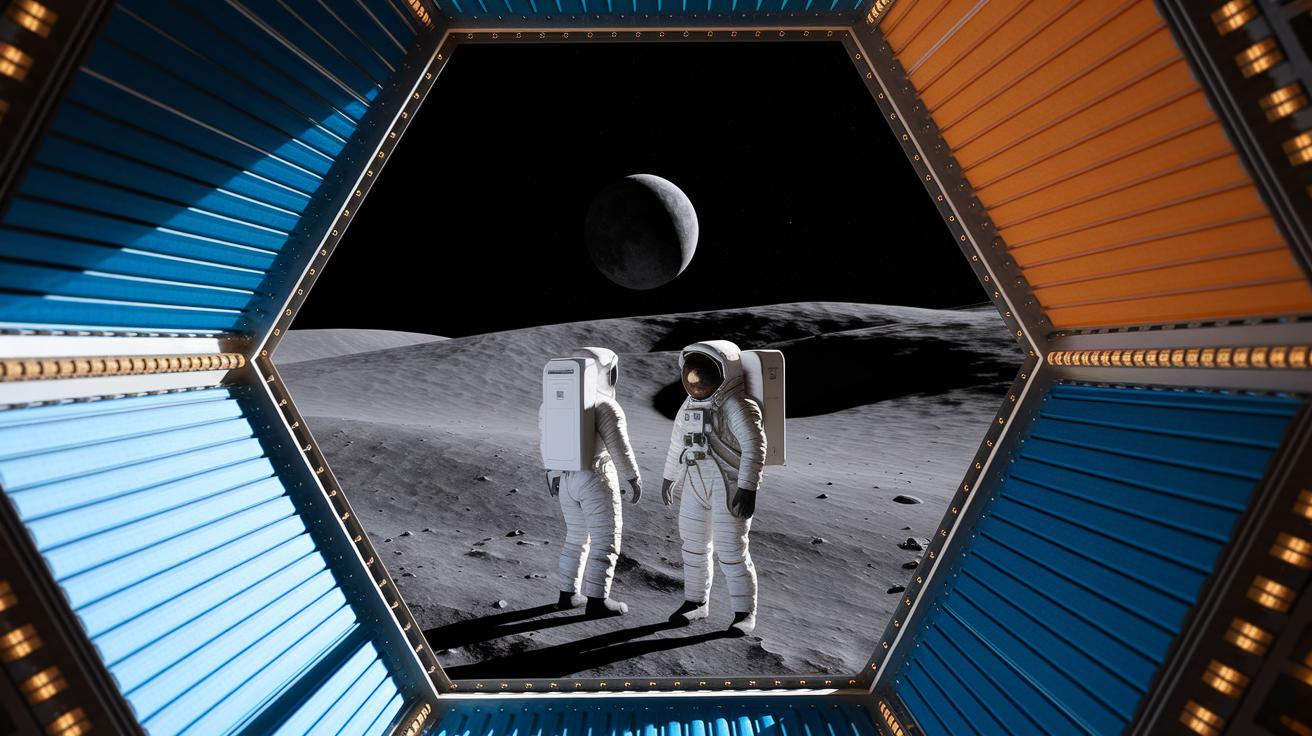
Lunar habitats have to deal with some really tough conditions. Imagine having to keep a building airtight at a pressure of about 101 kPa, even when the Moon’s pull is only 1/6 that of Earth’s. And then there’s the wild temperature swings, from a bone-chilling –173 °C during the long night to a sizzling +127 °C under the sun. To handle these extremes, engineers deck out these habitats with layers of insulation and smart systems that adjust the heat as needed. It’s a bit like wearing a smart jacket that ramps up or cools down all by itself as you move from the shade into the bright sun.
Another big challenge is shielding the people inside from dangerous cosmic rays and solar radiation. To keep this radiation below 50 mSv per year, these structures need a cover that’s as thick as about 2.5 to 5 meters of lunar soil. And speaking of lunar soil, or regolith, it isn’t just a problem, it’s also a handy resource. New techniques, like regolith-based 3D printing and sintering (a process that fuses particles together), let engineers make strong parts right on the Moon. This clever approach means we don’t have to send heavy building materials all the way from Earth.
Taking clues from the past, engineers are also inspired by designs like the Apollo-era lunar module. These modular units are key to building habitats that are both flexible and strong. With smart planning to keep out radiation, hold in air pressure, manage crazy temperature swings, and use local materials wisely, every design pushes us closer to safe and sustainable living on the Moon.
In-Situ Resource Utilization and Life Support Innovations in Lunar Colonies
Early lunar colonies face a big hurdle at first, they'll have to depend on supplies from Earth for water, air, and food until they can make the most of what’s available on the Moon. Colonists plan to use the Moon’s polar ice (about 600 million tons) so that one day, life on the Moon can run on local resources.
Imagine a lunar engineer saying, "Picture a system where every drop of water is saved and reused, kind of like a smart recycling unit at home." This idea is behind closed-loop water recovery systems that aim to reuse 90–95% of water with processes such as vapor compression distillation and microfiltration. It’s like having a giant water filter working around the clock right on the Moon.
There’s also an exciting plan to pull oxygen from the Moon’s soil (regolith, which is about 40–45% oxygen by weight). Techniques like carbothermal reduction or molten salt electrolysis can turn lunar soil into breathable oxygen while also giving us useful byproducts. This method helps cut down on the amount of stuff we need to bring from Earth. Plus, robotic mining systems will gather the lunar soil, and automated processes will sift out ilmenite, a mineral that offers both titanium and extra oxygen to support life.
On top of that, pioneers are exploring new ways to build habitats using local materials. They’re looking at printing constructions out of lunar soil, which could help create homes that naturally fit in with the Moon’s tough environment. These fresh ideas transform the barren lunar surface into a strong base for self-sustaining off-world living.
All these breakthroughs, from water recovery to oxygen production, are stepping stones toward lunar colonies that can look after themselves and, ultimately, help human life thrive beyond Earth.
Transportation and Infrastructure Logistics for Lunar Colony Operations

Planning the journey from Earth to the Moon is a lot like organizing a road trip on a cosmic highway. The Constellation Program splits the trip into two parts: one launch sends a vehicle from Earth, and another handles landing on the lunar surface. Splitting these steps lets each spacecraft save on weight and fuel, which is a smart way to tackle the challenges of space travel.
Getting from low Earth orbit to the Moon means managing a speed change of about 17 km/s. In plain terms, that means the engines must be very efficient, whether they’re powered by chemical rockets or nuclear thermal propulsion (engines that use nuclear energy for extra power). Many experts agree that solving these travel challenges is crucial for deep-space missions.
Cost is another big hurdle. Setting up a permanent colony on the Moon could cost between $250 and $500 billion. This budget covers everything from design and development to launching the vehicles and building the surface facilities. Every dollar counts when pushing our technology to its limits, and these financial needs shape many design choices.
Once the colony is established, reliable power becomes essential. Imagine using solar panels that not only capture sunlight with ease, but also feature a system to keep dust away and maintain their efficiency. At the same time, small reactors delivering 1 to 10 megawatts of constant power offer a dependable backup, especially when sunlight is scarce. Both renewable energy and nuclear options are being considered to ensure a steady flow of energy.
All these elements, from the travel plans to the cost details and power strategies, come together to lay a solid foundation for a lasting, functioning base on the Moon.
Governance, Collaboration, and Economic Models for Lunar Colonies
International teamwork is set to guide how lunar colonies are run. Organizations like NASA, ESA, CNSA, ISRO, and JAXA, along with innovative private companies, will share the tasks of managing a moon base. Picture a small crew of fewer than 100 people relying on strong mental support and clear communication, almost like a sports team that clicks because of constant teamwork.
Government programs and private ventures are working side by side to create a balanced plan. One official might say, "Our journey to a lunar colony depends on trust and collaboration as much as on advanced technology." When you look at the economic side, there are ideas like exporting helium-3 for energy, setting up local manufacturing that benefits Earth’s markets, and even creating lunar tourism spots for those with a taste for adventure.
We also need to remember that living in a small, isolated community means building strong bonds and practicing resilience. This thoughtful blend of clear rules, shared duties, and creative economic ideas forms the backbone of a lasting lunar colony.
Final Words
In the action, we explored the key ideas behind a lunar colony, from innovative habitat designs and resource extraction methods to efficient transport and solid governance plans. Our discussion highlighted NASA’s moon mission insights alongside private sector strategies and fresh economic models.
This post unpacked the nuts and bolts of building a sustainable, human habitat on the Moon, covering everything from life support to infrastructure logistics. It leaves us optimistic about a future where science and technology work hand in hand for out-of-this-world breakthroughs.
FAQ
What does the term lunar colony mean and what is its purpose?
The lunar colony means a planned human settlement on the Moon. It is designed to use local resources for building habitats and supporting scientific research while paving the way for sustainable off‐world living.
How does the concept of a lunar colony appear in video games like Overwatch, Mario Kart 8, or I Have No Mouth?
In these games, the lunar colony setting is used as a creative backdrop to enhance game themes and storylines. It gives players a futuristic, imaginative glimpse of life on the Moon.
What are some notable lunar colony facts?
Notable facts include designs based on engineering studies and NASA projects. Lunar colonies could use abundant local materials, like regolith, to build habitats and harness continuous solar energy at the lunar poles.
What does a Moon Colonization project involve?
A Moon Colonization project involves international efforts by space agencies and private firms to build a sustainable human presence on the Moon, utilizing local resources and advanced technologies to support long‐term missions.
Will we ever have a lunar colony?
Plans are moving forward with programs like NASA’s Artemis, implying that a lunar colony may become a reality in the coming decades as international partnerships and private initiatives evolve.
What did China find on the backside of the Moon?
Chinese lunar missions have discovered unique geological formations and surface compositions on the far side. These findings contribute important information about lunar history and the Moon’s evolution.
Is lunar water drinkable?
Lunar water, often found as ice deposits at the poles, must be processed and purified to remove impurities before it can safely be used for drinking and supporting human life.