


Have you ever wondered if nature might be speaking in its own, secret language? Quantum biology hints that our cells could be following hidden rules, almost like a tiny dance of particles happening right inside us.
Imagine peeking into your body and noticing that every little interaction carries a mysterious, rhythmic precision. This approach goes beyond our everyday view of life, showing us that there’s more to our natural world than meets the eye.
In this article, we’re exploring how these tiny quantum effects shape living systems and inviting you to see life from an entirely new perspective. It’s like discovering that the building blocks of nature have their own subtle, beautiful order, one that continuously fascinates scientists and curious minds alike.
Defining Quantum Biology: Atomic-Level Life Processes
Quantum biology is all about exploring how the quirky rules of quantum mechanics (the science of super tiny particles) shape the way life works. Instead of looking at big systems, researchers dive into the tiny world inside cells, where electrons, protons, and chemical bonds behave like a group of mini dancers performing a well-choreographed routine.
This field shifts focus from big, obvious interactions to the hidden actions happening at the atomic level. Think of it this way: phenomena like quantum coherence (when energy moves effortlessly through a protein, almost like a smooth wave) and quantum tunneling (where particles cleverly pass through hurdles that seem impossible) change the game. These surprises move us beyond the predictable rules of classical physics and invite us to rethink how life truly functions.
In short, quantum biology is the study of how life follows the mysterious rules of quantum physics. Scientists use tools like spectroscopy, theoretical physics, and even brief laser pulses to capture events that flash by in just a trillionth of a second. It’s like peeling back the layers of a secret script that directs every act of life, revealing that the building blocks of our existence are far more dynamic than we ever imagined.
Historical Foundations of Quantum Biology
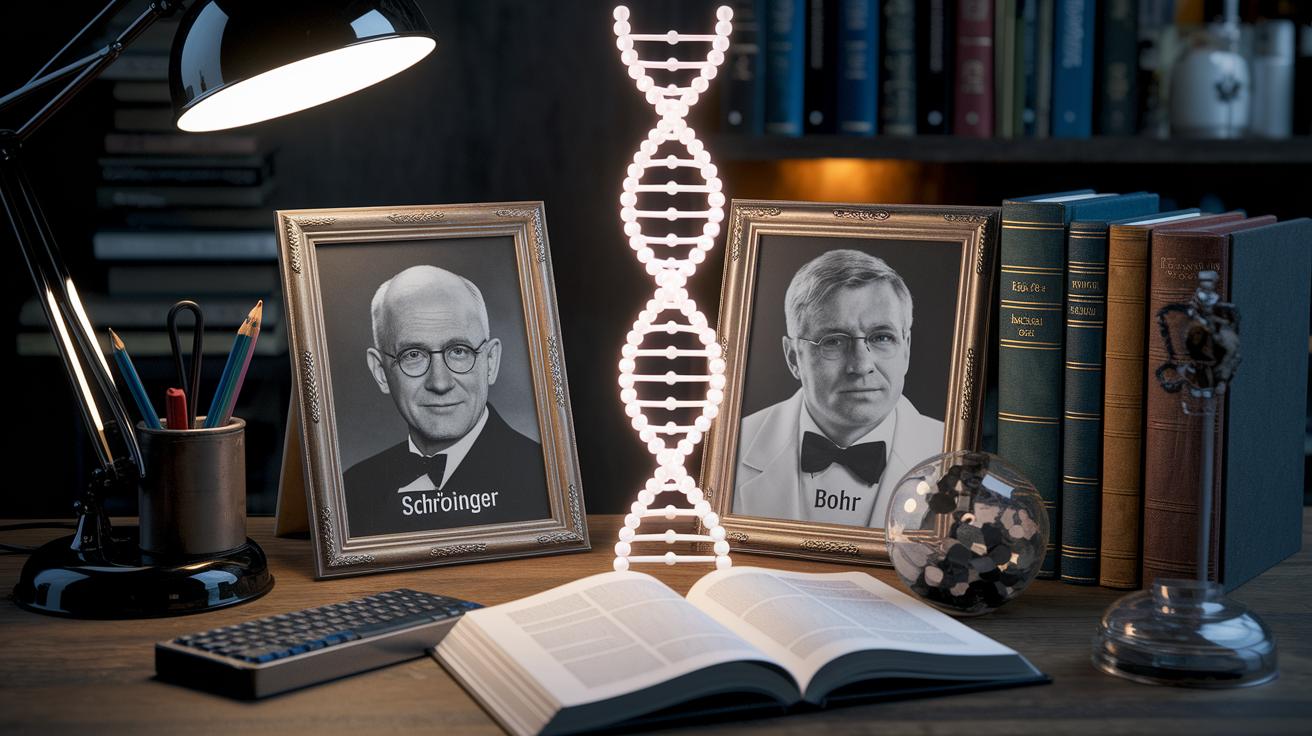
Quantum biology began taking shape back in the 1940s when Erwin Schrödinger asked a daring question in his book "What Is Life?" He noticed that the genetic code was amazingly precise, almost like it was set by some hidden, quantum magic. This idea made people wonder if tiny particles (like electrons) might play a special role in how living things work.
Then Niels Bohr added his own twist. He took his well-known idea that light acts both like a particle and a wave and suggested that living processes might follow similar rules. His thoughts pushed scientists to look at biology through the fascinating lens of quantum mechanics, a field that studies the smallest bits of matter (think of it as the science of nature's tiniest building blocks). For a fun peek at these quantum ideas and how they're linked to today’s innovations, check out what is quantum computing.
Even though many doubted these ideas back in the early days, those exciting theories have paved the way for today’s surge of interest. In recent years, more researchers have started to see that quantum principles might be the key to unlocking the mystery of what really happens at the atomic level in living systems.
Quantum Biology Mechanisms: Quantum Effects in Living Systems
Quantum biology helps us see how the smallest events can shape life itself. In photosynthesis (the process where plants turn sunlight into energy), energy moves so efficiently across protein setups that it almost looks like a perfectly choreographed dance. Scientists even found that using ultrashort laser pulses shows this energy flows with more than 90% efficiency, hinting that quantum coherence (particles syncing up) plays a big role.
Another cool process is proton-coupled electron transfer. Picture it like a perfectly timed dance between protons (tiny charged particles) and electrons (smaller particles that carry energy). Their smooth moves keep energy flowing during vital reactions like cellular respiration, which powers living cells.
Quantum entanglement also adds an intriguing twist. Some animals seem to navigate by sensing weak magnetic cues, as if guided by tiny messengers. This might be due to entangled radical pairs (molecules that share a unique connection) in their sensory proteins, helping birds and even fish find their way naturally.
And then there’s quantum tunneling. Imagine a hidden door that lets particles slip through energy barriers instead of taking the long road around. This “shortcut” at the atomic level lets them move in ways that seem almost magical.
Together, these quantum effects, coherence, entanglement, and tunneling, show us that nature operates by some surprisingly elegant rules, where even the tiniest parts play a big role in life.
Quantum Biology in Nature: Photosynthesis and Animal Navigation
Scientists are now exploring how tiny quantum effects work in living things using clever new experiments. They use a technique called two-dimensional electronic spectroscopy (a method that shows how energy travels between molecules) to watch how plants transfer energy in just a hundred femtoseconds, faster than a blink!
Researchers are also tweaking magnetic fields to track small changes in quantum pairs inside the eye proteins of animals. With advanced light-detecting tools, they can notice these tiny shifts and learn how magnetic cues steer biological functions.
| Method | Description |
|---|---|
| Ultrafast Spectroscopy | Watches energy moving through plant cells in super-short moments |
| Magnetic Field Manipulation | Tracks changes in eye proteins caused by tiny quantum effects |
Scientists are also looking at how everyday factors like temperature and background noise can challenge these quantum actions. Ongoing experiments and friendly debates are slowly revealing how nature uses this quantum precision to control energy flow and help animals navigate using magnetic cues.
what is quantum biology: a bright scientific fusion
Quantum biology is turning our understanding of medicine and technology upside down. Scientists have discovered that the tiniest parts of life follow quantum rules (the basic laws that govern very small particles), and these surprising insights are sparking new ideas for medical treatments. Take, for example, early work with metal-based cancer drugs like cisplatin and NAMI-A. These studies uncovered unexpected quantum behaviors that might just offer fresh ways to tackle cancer, kind of like the experiments were hinting, "Maybe there’s a whole new approach hidden in these effects!"
At the same time, nature’s own quantum tricks are inspiring the design of high-tech machines. Engineers are borrowing ideas from biological systems to build devices that pass energy along more smoothly. And here’s the exciting part: this approach may also unlock new ways to understand and treat neurodegenerative diseases, where tiny changes in cells can make a big difference.
Scientists are mixing tools from quantum optics (the study of light at a tiny scale), computer simulations, and detailed structural analysis to really get into how these processes work. Their work is bridging the gap between biology and technology by rethinking everyday problems at the atomic level. In doing so, quantum biology isn’t just reshaping our approach to treating illness, it’s also sparking the innovation behind tomorrow’s devices.
Quantum Biology Research: Current Studies and Future Directions
Researchers are turning quantum biology from a neat theory into real, measurable science. Since 2015, labs all over have been using cool tools like quantum optics (studying light on a tiny scale), spectroscopy (reading light’s unique signature), structural biology (looking at how molecules are shaped), and high-performance computing (using super-fast computers) to see how tiny quantum events make life tick. These techniques even let scientists watch electrons and protons in action, giving us a fresh look at how energy flows in living systems.
Back in 2015, a review in the Journal of the Royal Society Interface covered a December workshop with about 25 experts. They talked about where the research stands, the challenges of measuring events that flash by in an instant, and the exciting future of quantum biology. Imagine this: in one workshop, researchers shared ideas that changed the way we see energy moving inside cells, hinting at whole new models for biological function.
Some scientists are also comparing natural quantum effects with man-made systems, quite like how quantum computers work. This side-by-side look is sparking ideas that could open up breakthroughs in both biology research and new technology design.
Key research techniques include:
- Quantum optics: exploring how light interacts at a very tiny scale.
- Ultrafast spectroscopy: catching events that happen in just trillionths of a second.
- Structural biology: mapping out the detailed shapes of molecules.
- High-performance computing: simulating the complex dance of quantum behaviors.
Final Words
In the action, we explored the basics of atomic-level life processes and how quantum mechanics influences living systems. We touched on historical insights from Schrödinger and Bohr, and we looked at phenomena like coherence in photosynthesis and magnetic cues in animal navigation. We wrapped up by examining how these tiny processes inspire new technologies in medicine and computing.
This article reminds us that deep questions like what is quantum biology spark innovative ideas, keeping our outlook bright and full of promise.
FAQ
What is quantum biology pdf?
A quantum biology PDF offers a document that explains how tiny particles in living systems behave, linking quantum mechanics with life processes like energy transfer and chemical reactions.
What is quantum biology in humans?
Quantum biology in humans explores how quantum phenomena might play a role in processes like enzyme reactions and neural activity, offering insights into the atomic-level functions of our cells.
What is quantum biology degree?
A quantum biology degree trains students to study the intersection of quantum physics and biology, covering topics such as electron behavior in molecules and the quantum basis of biological reactions.
Is quantum biology real?
Quantum biology is a real scientific field that investigates the influence of quantum principles on living systems by applying experimental and mathematical tools to study subatomic processes in nature.
Are there any quantum biology books?
Quantum biology books break down how quantum mechanics affects biological processes, often explaining concepts like electron tunneling and coherence in clear, accessible language.
What are quantum biology applications?
Quantum biology applications include inspiring new medical treatments through better understanding of energy transfer in cells, guiding the design of advanced materials, and informing novel computational models.
Can you provide quantum biology examples?
Quantum biology examples range from the nearly perfect energy efficiency in photosynthesis to animal magnetoreception, where quantum effects help some species sense Earth’s magnetic field.
What do quantum effects in biology mean?
Quantum effects in biology refer to phenomena such as coherence, tunneling, and entanglement that control how electrons and protons behave at the atomic level in various biological reactions.
Does quantum biology explain consciousness?
Quantum biology touches on aspects of brain function and cell signaling, but it does not fully explain consciousness, which remains a complex topic with contributions from many scientific fields.
Where can I study quantum biology?
You can study quantum biology in specialized interdisciplinary programs that combine physics and life sciences, often found in leading research universities and institutions known for biophysics.
What is quantum science in simple terms?
Quantum science in simple terms examines how extremely small particles behave in ways that differ from everyday expectations, providing a framework to understand natural processes at a molecular level.
How does quantum relate to biology?
Quantum relates to biology by revealing how atomic-scale actions, like electron movement and energy transfer, underlie many key biological processes, offering a deeper look into the mechanics of life.